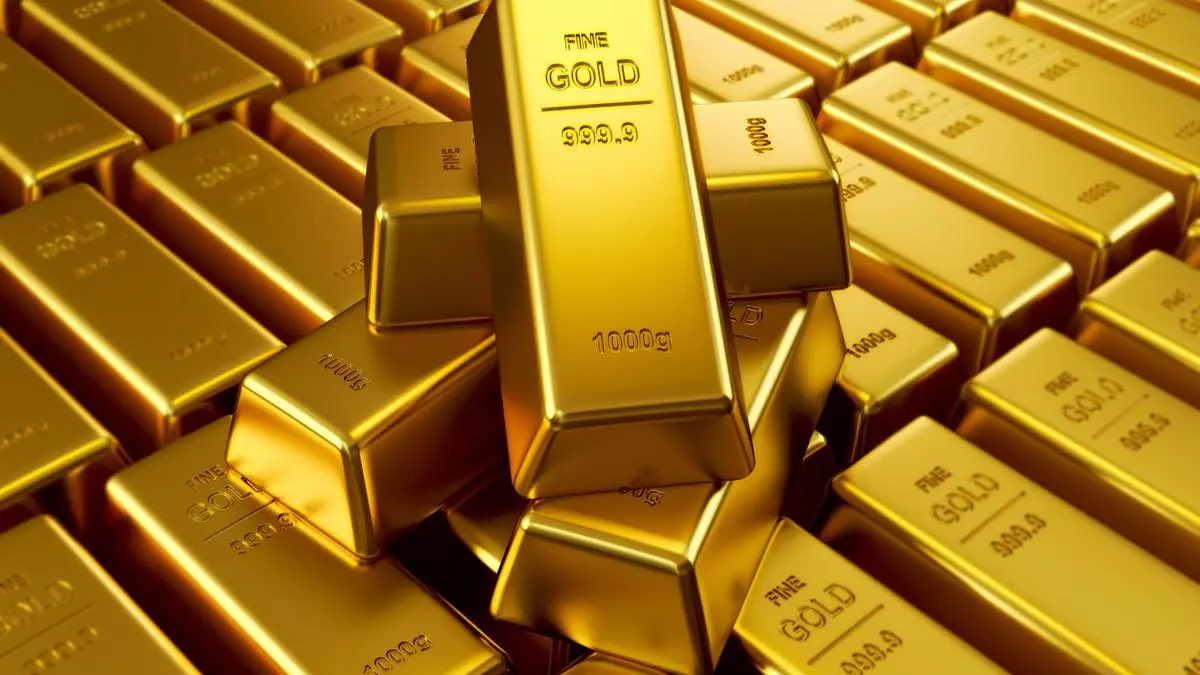

3D illustration of a gold bars.
| Photo Credit:
Stiggdriver
Central banks across the world continued buying gold for the third consecutive month in June, data from the World Gold Council (WGC) showed. It was the highest purchase by them this year.
“Central banks bought 51 tonnes of gold in June, with Poland and China continuing to lead gold accumulation. Buyers for the month included Uzbekistan, Kazakhstan, Jordan, the Czech Republic, Ghana and Georgia. Net sellers were Russia and Turkey,” said Marissa Salim, Senior Research Lead, APAC, WGC.
In the first half of this year, central banks reported buying 102 tonnes, with purchases spread across a broad cohort of emerging market central banks.
In March, central banks sold a net 30 tonnes of gold. Since then, they have been net buyers, purchasing 17 tonnes in April and 41 tonnes in May.
Poland largest buyer
Salim said the National Bank of Poland was the largest buyer in June, adding 19 tonnes more to its reserves.
The People’s Bank of China followed with a purchase of 15 tonnes. With this, the Chinese bank has been buying for 20 consecutive months.
Other central banks to procure gold in June were Uzbekistan (9 tonnes) and Kazakhstan (7 tonnes). Both continued their buying-spree.
Jordan bought (3 tonnes), Georgia (1 tonne) and Ghana (1 tonne) re-entered the market in June. Others to procure the yellow metal were the Czech Republic (2 tonnes) and Turkey (2 tonnes).
Though Turkey purchased 2 tonnes, it also sold a similar quantity. Russia continued to be the biggest seller of gold, offloading 9 tonnes.
Turkey largest seller
At the end of the first half, Poland remained the top buyer, accumulating 82 tonnes, followed by Uzbekistan, which has purchased 41 tonnes.
China and Kazakhstan have been the other major procuring nations, buying 40 tonnes and 27 tonnes, respectively.
Other net buyers were the Czech Republic (11 tonnes), Singapore (10 tonnes), Chile (8 tonnes), Jordan (6 tonnes) and Ghana (6 tonnes). Emerging economies, too, purchased the precious metal in smaller lots.
Though Russia has been continuously selling the yellow metal, Turkey emerged the largest seller of gold in the first half of the year. It sold 83 tonnes, with most of its selling activity concentrated in the first quarter, particularly March.
However, in the second quarter, it sold only 4 tonnes. Russia sold 44 tonnes in the first half.
Russian problems
Russia has been offloading the yellow metal from its official reserves to cover its budget deficit, as defence expenditure has risen due to the Ukraine war. It has also been losing oil and gas revenues due to Western sanctions. The Western nations, led by the US and its allies in the North Atlantic Treaty Organisation (NATO), have frozen Russians’ foreign assets. This has forced the Kremlin to liquidate physical gold and alternative reserves like the Chinese yuan.
Turkey, on the other hand, sold and swapped 58-60 tonnes of gold worth $8 billion to protect its currency, the lira, and its foreign exchange reserves.
Gold buying by central banks has been one of the major reasons for the yellow metal to rally continuously since 2024. It peaked at $5,608 an ounce on January 29.
However, after the Iran war broke out, it has shed over 25 per cent of its gains on fears of inflation, rising bond rates, hopes of the US Fed increasing interest rates and investors switching to energy commodities.
On Wednesday, gold traded at $4,167 an ounce, up over three per cent since the beginning of this week on hopes of a US-Iran deal.
Published on August 5, 2026