Ashwini Vaishnaw, India’s IT minister, said India could attract over $200 billion in data-centre investments over the years. Addressing a press conference at a 3DExperience World event in Houston, Nvidia chief executive Jensen Huang said data centres could generate huge upstream and downstream employment in India, just the way the internet did.
However, execution is the key, and it faces several constraints, including land, energy, water and talent.
Capacity surge
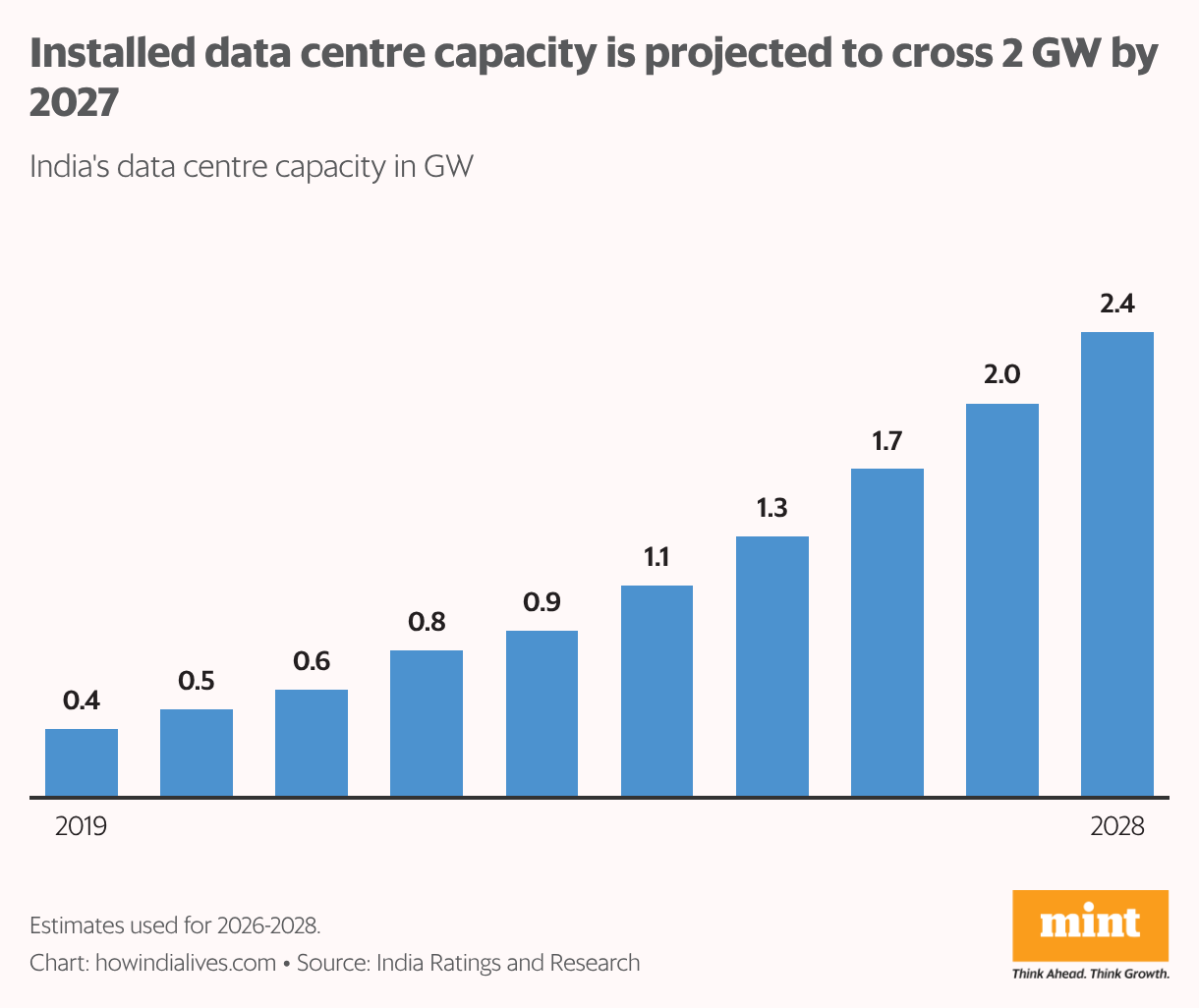
India’s data-centre capacity has surged from 350 megawatts (MW) in 2019 to an estimated 1.3 gigawatts (GW), or 1,000MW, in 2025, according to India Ratings and Research. In 2025, the agency estimated it would grow to 1.7GW in 2026 and to over 2GW by 2027. The tax holiday could boost this further.
Three categories of players now dominate the market: global hyperscalers such as Amazon Web Services, Microsoft, Google and Meta, which are increasingly colocating AI-optimized facilities; Indian operators and joint ventures, including Yotta, Nxtra, AdaniConneX, Sify and CtrlS, which run data centres for enterprise and cloud clients; and telecom-linked conglomerates such as Reliance Industries, integrating cloud, connectivity and data centre assets for domestic and regional markets.
All three segments have been growing, driven by surging digital demand. The announcement is aimed at boosting these further, while balancing them with safeguards for domestic ownership and taxation. For instance, to receive tax exemptions, foreign companies must use data centres owned and operated by an Indian company. Similarly, services offered to Indian users must be routed through an Indian reseller entity.
AI imperative
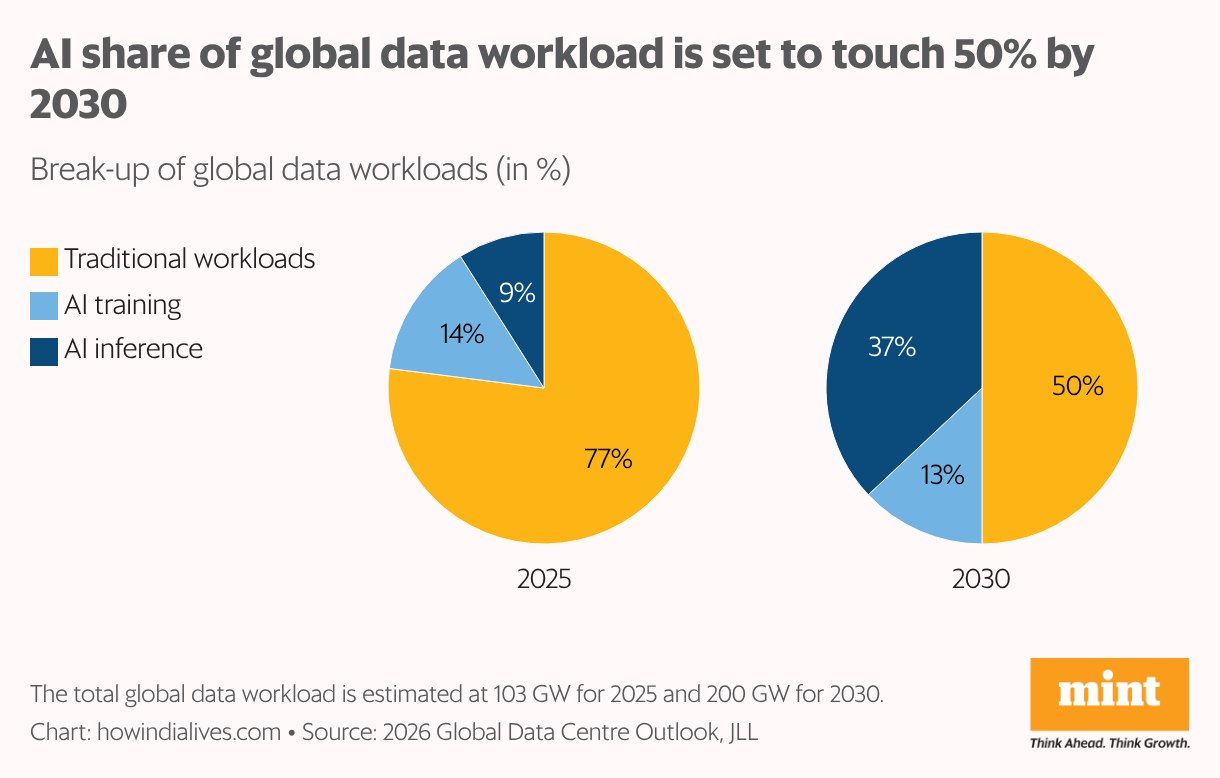
Artificial intelligence is the primary driver of data-centre expansion in India, as it is globally. AI workloads accounted for 23% of data-centre capacity in 2025, up from 5% in 2020. It is projected to reach 50% by 2030, according to JLL, a real estate services firm.
While India generates nearly 20% of global data, most of it has historically been stored or processed overseas. This gap is now narrowing as the need for local storage and low-latency access for AI systems drives domestic capacity demand. Major cloud providers, including Amazon Web Services (AWS), Microsoft Azure and Google Cloud, are increasingly shifting AI compute operations to India.
India’s broader goal is to build the infrastructure needed to support domestic AI development rather than depend entirely on foreign regions for compute. Policy measures, including long-term tax certainty, are intended to anchor early-stage AI training, model deployment and enterprise use within India. This aligns with India’s stated ambition to build sovereign AI capabilities and expand its role in global AI infrastructure.
If the tax holiday succeeds in attracting investments, it will expand local capacity. This, in turn, could lower costs and improve speed, reducing reliance on overseas centres. Indian startups could benefit.
Shifting centres
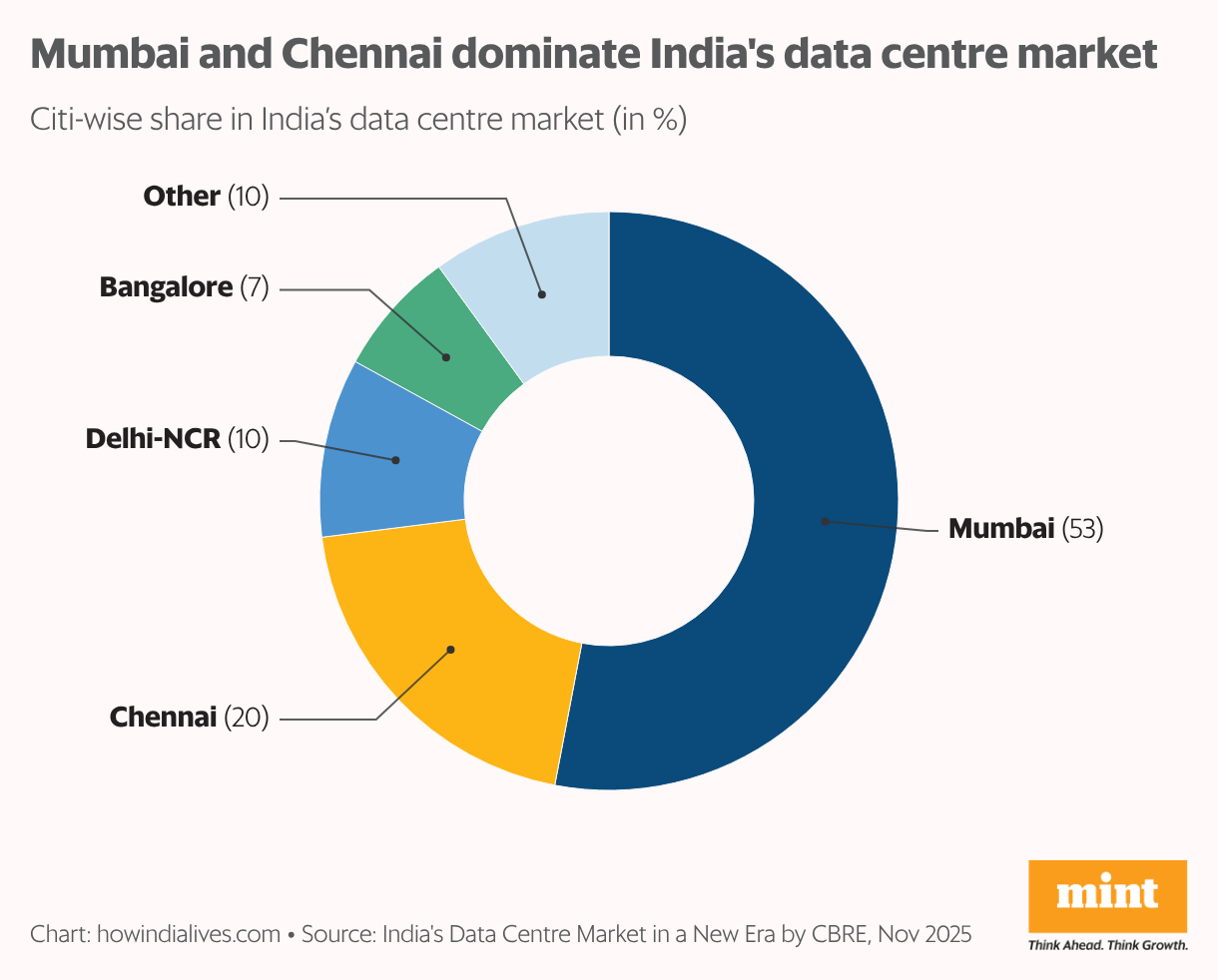
India’s data-centre capacity is concentrated in a few hubs, with Mumbai holding 53% of the market, Chennai about 20%, and Delhi, Bengaluru, Pune, Hyderabad, and Kolkata accounting for the rest, according to CBRE. These clusters emerged due to reliable power, strong fibre routes, subsea cable access, and suitable industrial land. As Mumbai and Chennai tightened, operators shifted towards locations with more land and grid capacity, pushing growth to Navi Mumbai, Greater Noida, Visakhapatnam, and Kochi.
AI workloads are reinforcing this shift. AI facilities require larger sites, stronger substations and expanded cooling, which several tier-II regions can offer. New AI-focused projects, including those planned in Visakhapatnam, reflect this trend. The Budget 2026 will aid this dispersion. To qualify for the tax holiday, centres must be Indian-owned and notified by MeitY, encouraging expansion in tier-II markets where land is cheaper. The tax holiday through 2047 reduces concerns about future tax exposure and makes sites outside the Mumbai-Chennai corridor more viable for global cloud firms.
Strained resources
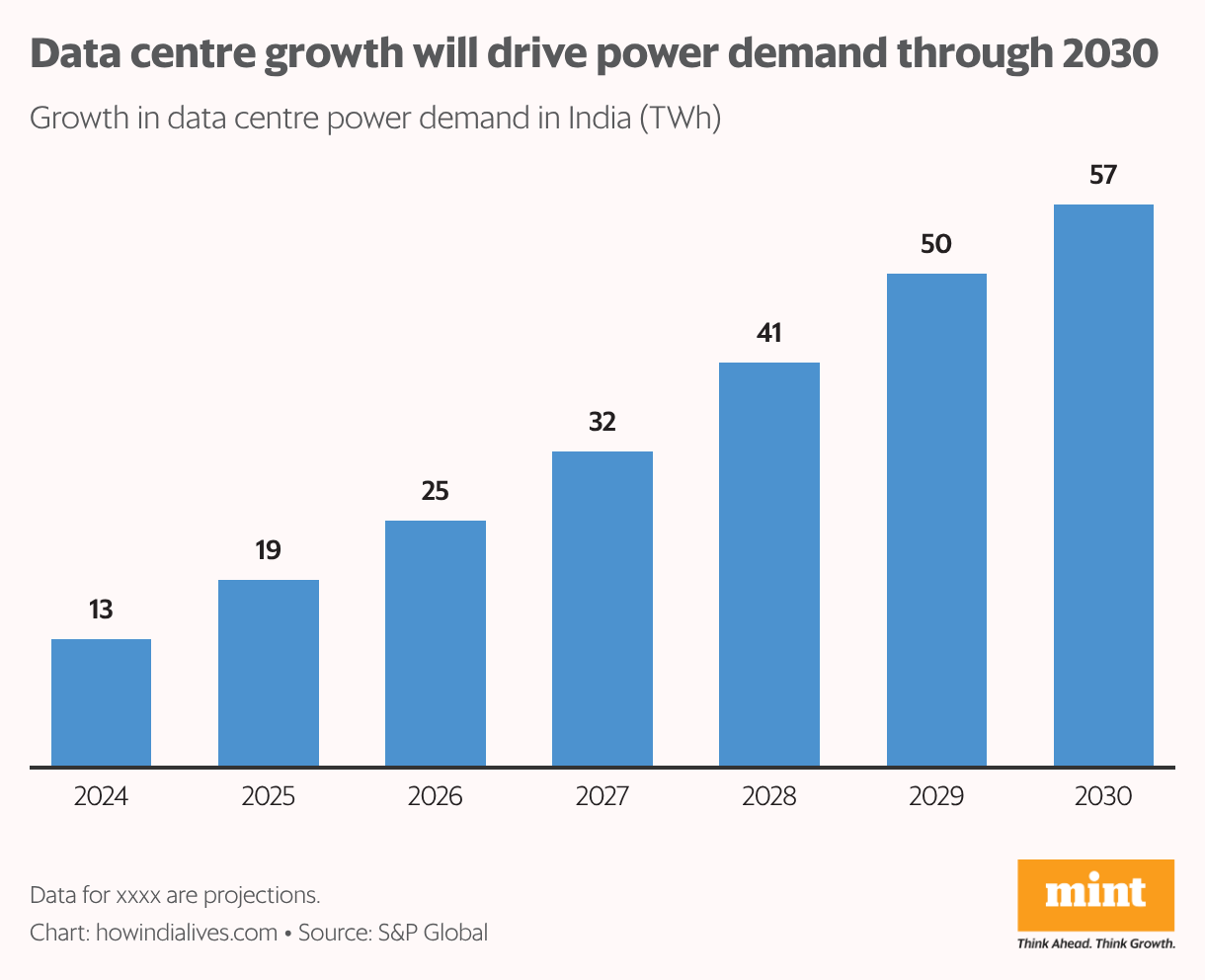
The intent to disperse also reflects the constraints facing data centres. They consume significant energy, water, and land resources. Power demand is projected to touch 57TWh by 2030 from 13TWh in 2024, according to S&P Global.
The growth is particularly driven by AI. AI workloads require 30-50kW per rack, compared with 6-12kW for traditional servers. They need water for cooling. A single 100MW campus uses water equivalent to a town of 85,000 people annually. This creates friction in water-stressed hubs like Mumbai, Chennai, and the National Capital Region, where groundwater levels have dropped sharply near data-centre clusters.
S&P Global predicts that 60-80% of India’s data centres will face high water stress this decade.
Land requirements are equally acute. A 10MW facility needs roughly 10 acres. Hyperscale campuses demand far more, forcing concentration near cable landing stations and depleting prime urban space. India has granted infrastructure status to data centres and offered state-level incentives, including electricity-duty waivers. The government has set renewable-energy targets of 500GW by 2030, with a push toward nuclear power and liquid-cooling technologies.
Global contest
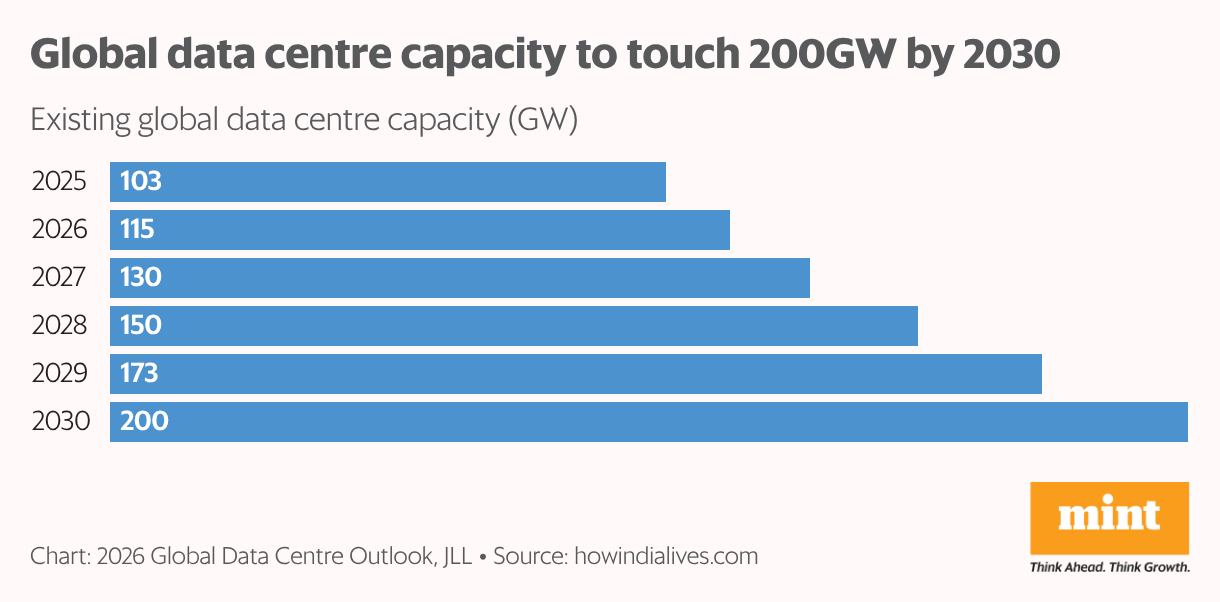
India is a part of a global race to attract data-centre and AI-compute investments. Nvidia’s Jensen Huang has termed the phenomenon “the largest infrastructure build-out in human history”. Global data-centre capacity is projected to grow to 200GW by 2030 from 103GW in 2025, according to JLL.
India has advantages. Development costs run approximately $5.4-6.8 million per MW, second only to China and significantly cheaper than the US, UK or Japan, according to Cushman & Wakefield. Industrial power tariffs in key states are lower than in developed markets like the UK and Germany. Geographically, India sits at the intersection of cable routes connecting Europe, the Middle East and Southeast Asia, with Mumbai and Chennai adding subsea cable capacity that rivals Singapore, which faces land and power constraints. However, India itself faces the risk of “data dumping”. It refers to foreign firms relocating resource-inefficient facilities rejected by stricter jurisdictions. Google’s Chile project was halted over aquifer depletion concerns. India also confronts a talent cliff. While India’s IT workforce is large, there’s a critical shortage of specialised technicians to support data centres. Advanced economies possess greater operational maturity.
www.howindialives.com is a database and search engine for public data