The STT on futures was increased in Budget 2026 by 150% to 0.05% and that on options by 50% to 0.15%. However, the STT on futures has a bigger impact because it is calculated on the notional or total contract turnover. In options, the tax is calculated on the premium turnover, which is the actual traded value and therefore tends to be less than the notional turnover.
Analysts and brokers estimate that the increase in the cost of trading options will be way lower than that for trading futures. This could make jobbers and scalpers, who take frequent positional trades during the day and operate on wafer-thin margins, to shift from futures to options.
HDFC Securities calculates that STT comprises about 10% of the cost of trading options compared with 84% of the cost of trading futures.
“The doubling in the trading cost of futures could push some jobbers and scalpers to options, where they can trade synthetic futures through options, where the increase in overall cost of trading will be around 3-5% only,” said Amit Chandra, VP (research) at HDFC Securities.
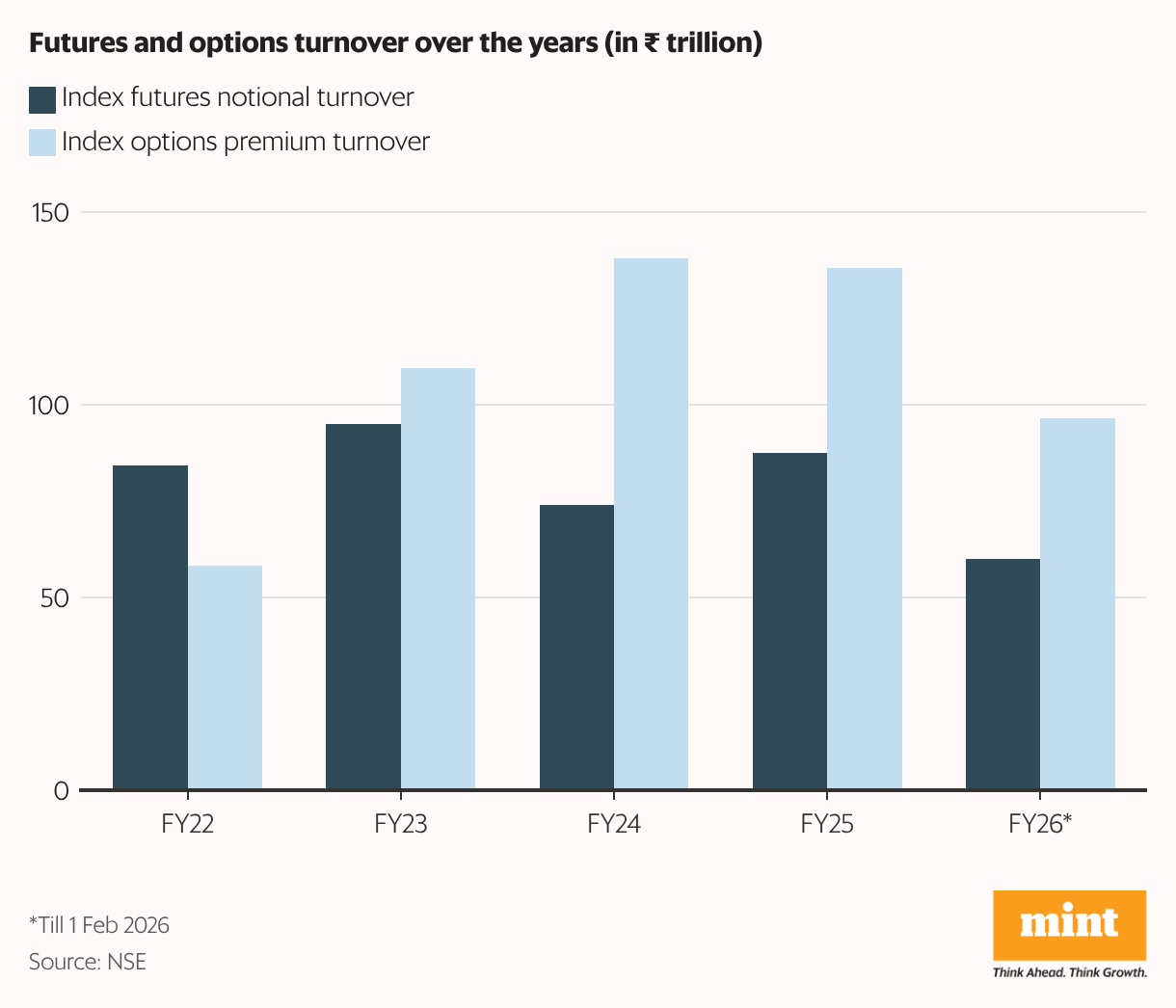
Options have a larger share of the trading pie than futures and so the hit to the overall derivatives turnover would be 10-15%, said Rajesh Palviya, head of research (derivatives & technical) at Axis Securities.
Options accounted for 75% of the National Stock Exchange’s transaction income of ₹2,760 crore in Q2 of the current fiscal, with futures contributing 11% and cash and currency derivatives the rest. The NSE had a market share of 77.1% in equity options as of 31 December, with the BSE accounting for the rest.
Options as a proxy
“Options can proxy as futures in certain combinations,” said Ashish Nanda, chief business digital officer at Kotak Securities. “Some trading interest can thus shift to options from futures.”
For example, the buying of a call option and the selling of a put option are the equivalent of buying a futures contract, while the selling of a call option and the buying of a put option is similar to selling a futures contract.
Nanda estimates that the STT for options on an average order size of ₹10,000 per lot will increase to ₹15 from ₹10 from 1 April. On a ₹17.5 lakh per lot order of index futures, the STT cost will surge to ₹875 from ₹350.
One reason for the STT increase in the budget is to dissuade retail investors from trading in derivatives, where the Securities and Exchange Board of India estimates nine out of 10 traders lose money.
Either way, the government will win, said Nanda. If retail participation falls, the losses are cut, and if it doesn’t, the government gets more revenue by way of higher STT, he said.
“Some futures traders may shift toward intraday cash, which is likely the government’s expectation. However, a significant portion of futures traders are positional and carry trades overnight,” said Mohit Mehra, vice president (primary markets and payments) at Zerodha, the country’s second-largest brokerage by number of clients. “These traders cannot move to intraday cash, and with MTF (margin trade funding) trades carrying 4 times the STT (0.1% on both sides compared with 0.05% on sell in futures), options may be the only viable alternative for them.”
Differential in increase
“Additionally, the percentage increase in STT itself is higher for futures compared to options. Since options already account for about 85% of total derivative traded contracts, with futures at roughly 15%, this differential impact could further tilt trading activity towards options,” said Roop Bhootra, whole-time director at Anand Rathi Share and Stock Brokers Ltd.
Gautam Kalia of Mirae Asset and Prakash Gagdani of Soaring Peaks Capital also said they expect volumes to shift to options from futures.
The government earned ₹52,196.86 crore through STT in FY25. It had budgeted STT collections at ₹78,000 crore for FY26, which was revised to ₹63,670 crore due to a drop in derivative volumes owing to a slew of regulatory measures like tripling the contract size and limiting weekly option expiry launches to one per exchange from multiple launches earlier.
The government has estimated STT collections of ₹73,700 crore in the next fiscal, following the STT increase on derivatives.