The new Viksit Bharat Guarantee for Rozgar and Ajeevika Mission Gramin (VB-G RAM G) scheme, to be notified by the Centre, will give states six months’ transition time. During this interim phase, the outgoing Mahatma Gandhi National Rural Employment Guarantee Act (MGNREGA) scheme will continue to operate as usual, necessitating a separate budgetary allocation, according to rural development and agriculture and farmers’ welfare minister Shivraj Singh Chouhan.
A proposed allocation of ₹1.51 trillion for VB-G RAM G has been made for the coming financial year, of which ₹95,600 crore will be contributed by the Centre, Chouhan told Mint in an exclusive interaction. The rest of the money will be contributed by states.
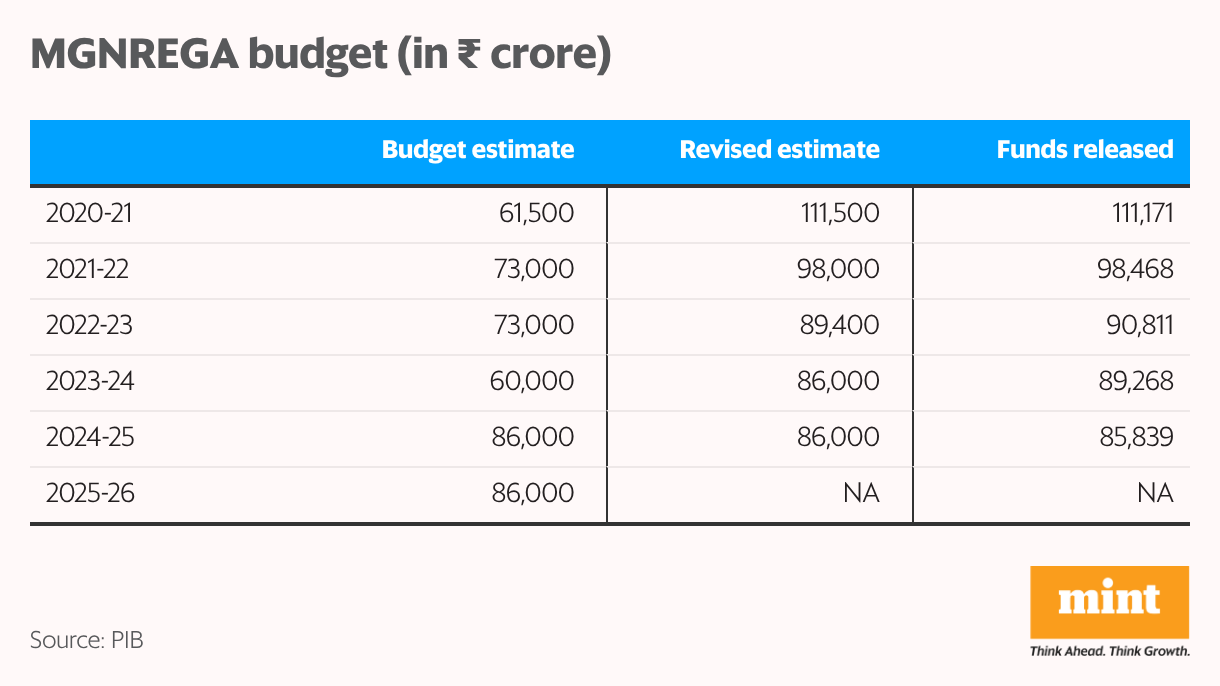
While the minister confirmed there would be an allocation for MGNREGA as well, he did not disclose the amount proposed. In both FY25 and FY26, the MGNREGA scheme was given an identical allocation of ₹86,000 crore, the highest in its lifetime.
“Based on demand, adequate provisions will be made for MGNREGA in the coming financial year during the transition period,” Chouhan said. “Until the Viksit Bharat G-RAM-G scheme is fully implemented, there would be no shortage of work under MGNREGA wherever employment is required.”
The VB-G RAM G scheme guarantees 125 days of employment, compared to 100 days in MGNREGA. Under MGNREGA, the Union government bears 100% of the wage costs, which constitute the bulk of the expenditure, while states contribute 25% of the material costs.
However, under the VB-G Ram G scheme, the Centre will fund only 60% of the total cost in most states, and 90% in north-eastern and Himalayan states, with the state governments funding the balance.
According to a senior government official who requested anonymity, given that the new scheme will follow a different funding pattern from MGNREGA, maintaining distinct allocations is to ensure uninterrupted wage payments and smooth execution of ongoing works, while allowing states adequate time to realign administrative and financial systems.
“The central government will soon frame rules for seamless transition of existing MGNREGA workers into the newly enacted VB-G RAM G scheme, and rules for the normative allocation of funds to states will also be notified soon,” said another official in the rural development ministry, also requesting anonymity.
“Instead of a top-down approach, works will be identified through Developed Gram Panchayat Plans, with Gram Sabhas and Panchayats deciding local priorities,” said Chouhan, adding that at least 50% of the works will be executed through Gram Panchayats, not contractors.
“Also, stronger administrative capacity is expected to improve planning and execution, enhance service delivery, and reinforce accountability, ensuring that the objectives of the new framework are achieved consistently at the village level,” added Chouhan.
To be sure, the government takes the final call on budget allocations closer to the budget announcement on 1 February, keeping in mind revenue and economic growth forecasts as well as savings in revenue spending.
Queries emailed to the spokespersons of the ministries of finance and rural development on 20 January remained unanswered till press time.
Implementation is key
Experts say the government should focus on meeting the targeted 125 man-days under the new scheme, as the average man-day was less than 50.24 days per household under MGNREGA in FY25, as per the officials cited above.
“It is a positive reform that the government has indicated an increase in budgetary allocation,” said Devinder Sharma, an agricultural policy expert. “However, the emphasis should be on effective implementation to ensure the targeted number of man-days is achieved and more workers are brought under its ambit.”
Shweta Saini, founder and chief executive officer (CEO), Arcus Policy Research, said the VB-G RAM G scheme is expected to have a multiplier effect, as it focuses on income generation by providing more man-days of employment to workers while also strengthening infrastructure creation.
“However, since the scheme requires state co-funding, its effective implementation will largely depend on the financial capacity and administrative preparedness of the states,” Saini said.
According to EY India, the government’s indication of a higher allocation for VB-G RAM G signals a strategic shift in rural employment policy from wage support to development-linked, asset-creating interventions aligned with the Viksit Bharat 2047 vision.
With the scheme replacing MGNREGA and raising the statutory guarantee to 125 days per rural household, enhanced funding is essential to convert entitlement into actual delivery, given past shortfalls caused by funding constraints.
Amit Vatsyayan, partner and social sector leader at EY India said that if the VB-G RAM G scheme is executed well, it can boost rural incomes and consumption in the short term, “while enabling creation of durable assets such as water conservation, irrigation, and rural infrastructure”.
“Over time, this can raise productivity, reduce distress migration, and strengthen household resilience, provided execution discipline and timely fund releases are ensured,” he added.
Twenty years of MGNREGA
Enacted in September 2005, MGNREGA provides guaranteed wage employment to rural households willing to undertake unskilled manual work.
Over the years, a range of administrative and technological reforms strengthened its implementation and, as a result, women’s participation rose steadily from 48% to 58.15% between FY14 and FY26, according to data from the rural development ministry.
However, alongside these gains, deeper structural issues persisted. Monitoring across several states revealed gaps such as work not found on the ground, expenditure not matching physical progress, use of machines in labour-intensive works, and frequent bypassing of digital attendance systems.
Over time, misappropriation accumulated, and only a small proportion of households was able to complete the full 100 days of employment in the post-pandemic period.