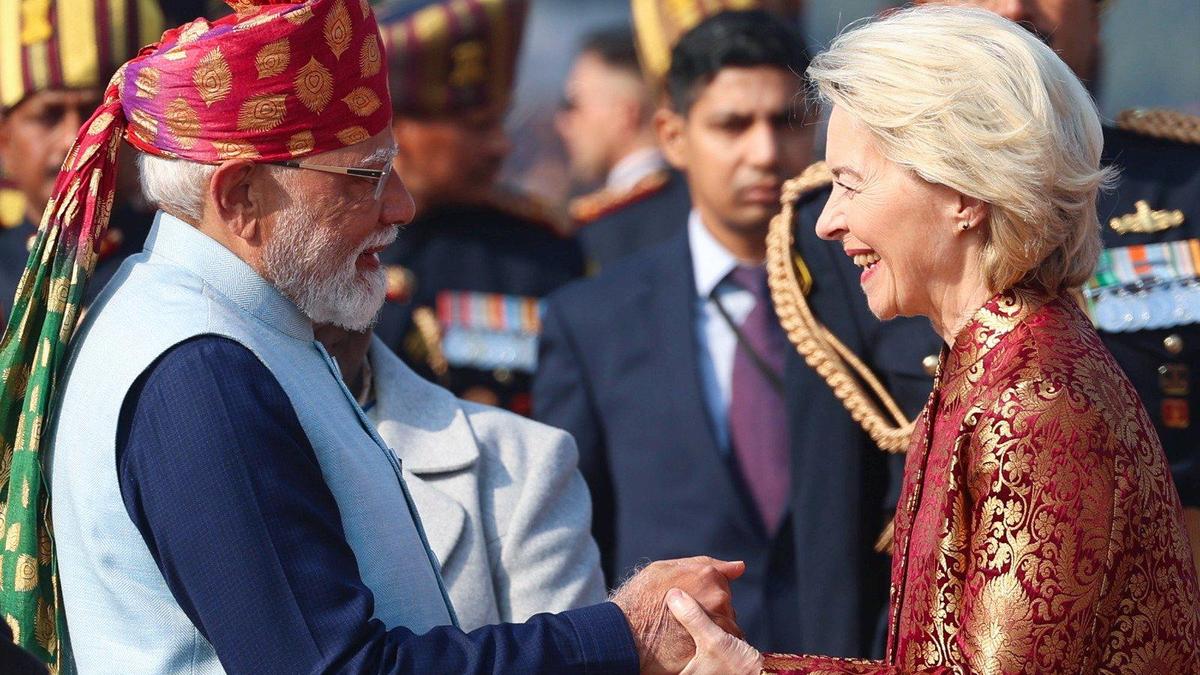
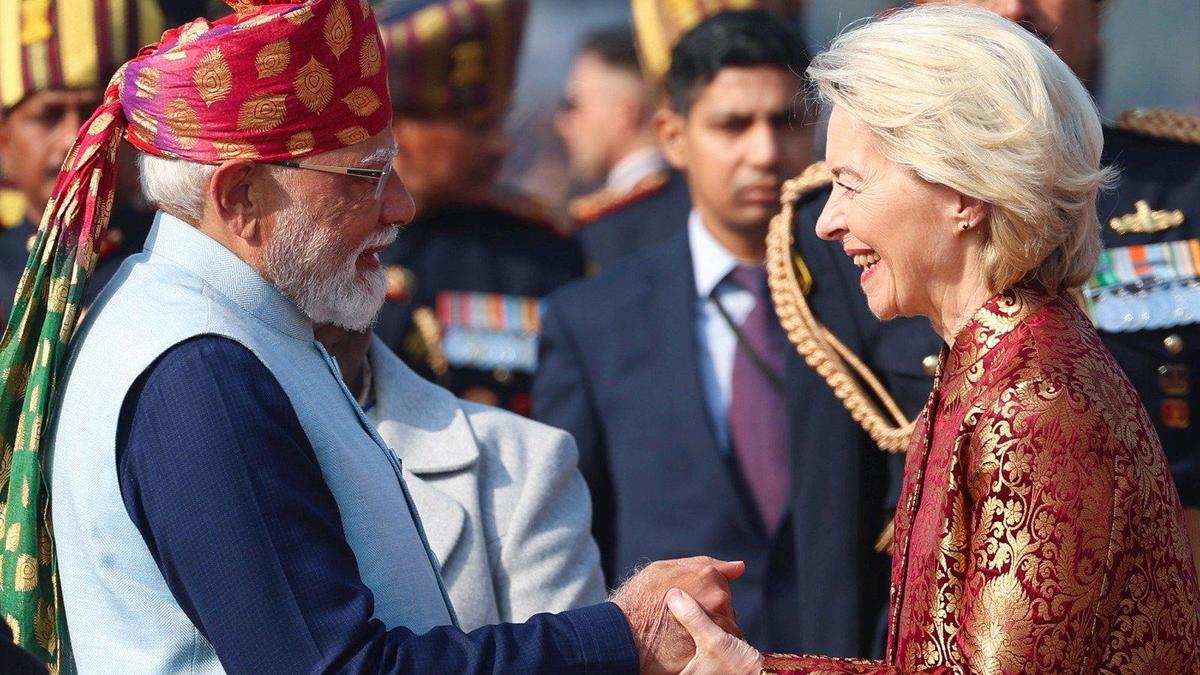
President of the European Commission Ursula von der Leyen is being received by Prime Minister Narendra Modi during the national flag hoisting at Kartavya Path on the occasion of the 77th Republic Day celebrations, in New Delhi on January 26, 2026.
| Photo Credit: ANI
A “successful India” is in the world’s interest, said visiting European Union leaders, as officials in New Delhi confirmed that negotiations for the EU-India Free Trade Agreement (FTA) have been concluded.
“The leaders of both sides will [on Tuesday (January 27, 2026)] sign a document signifying the closure of negotiations,” Commerce Secretary Rajesh Agrawal told reporters on Monday (January 26, 2026) adding that “the legal scrubbing of the language” would take place after that.
Also Read | India to slash tariffs on cars to 40% in trade deal with EU, sources say
Mr. Agrawal said that the final outcome was a “balanced, forward-looking deal that would propel trade and deeper economic integration between the two sides”. Separately, sources in the Commerce Ministry said that negotiations were concluded on Friday (January 23, 2026) and the deal was approved by both sides on Saturday (January 24, 2026).
The deal is part of a number of other agreements, including a Security and Defence Partnership, energy cooperation and a mobility agreement expected to be signed during the EU-India summit between Prime Minister Narendra Modi, EU Commission President Ursula von der Leyen and European Council President Antonio Costa on Tuesday (January 27, 2026).
The presence of the EU’s top leadership “underscores the growing strength of the India-European Union partnership and our commitment to shared values”, said Mr. Modi in a post outlooking the agreements.
On Monday (January 26, 2026), all the leaders attended the Republic Day parade, in which EU defence commanders took part for the first time, and EU Presidents were hosted at Rashtrapati Bhawan by President Droupadi Murmu. “A successful India makes the world more stable, prosperous and secure,” Ms. von der Leyen said in a post, adding that the world’s largest democracies Europe and India are committed to shaping “a new global order”.
The leaders witnessed the parade where India’s military hardware and marching contingents, particularly those involved in Operation Sindoor in May 2025 against Pakistan, were showcased. Significantly, much of the hardware that Ms. von der Leyen and Mr. Costa witnessed in the parade was Russian-made or designed and has been sanctioned under various EU sanction packages since Russia’s invasion of Ukraine in February 2022.
“An opportunity to recall the importance of the action of the EU Naval Forces to enhance maritime security and protect the freedom of navigation, in particular in the Indo Pacific,” Mr. Costa said on social media, steering clear of any contentious references to the war in Europe.
Also Read | India and EU are showing a fractured world another way to engage: EU chief Ursula von der Leyen
The EU-India FTA conclusion marks the end of a two-decades-old process, after talks were first launched in 2007. The talks have faltered on a number of occasions, particularly over seemingly irreconcilable issues like market access for “sensitive” European agricultural and dairy items, environmental regulations, investment and immigration. After a freeze on talks between 2014 and 2022, the talks were relaunched with more pragmatic goals, and both sides have reportedly agreed to set aside sectors where they failed to find common ground. Once the FTA is announced on Tuesday, officials will complete the legal scrubbing, and it will be sent to all 27 EU states after being translated, before it is ratified by the European Parliament.
With bilateral trade already crossing $136 billion, the sources also said that this would be “one of the biggest” bilateral deals in the world. Unlike ASEAN countries, the EU acts as a single customs bloc, they explained. The EU has FTAs with eight countries and has signed an FTA with the South American bloc MERCOSUR earlier this month. Both India and the EU are also expected to upgrade their strategic partnership, first concluded in 2004, and upgrade defence cooperation and military engagement in areas including maritime security, cyber security and counter-terrorism.
Published – January 26, 2026 08:37 pm IST