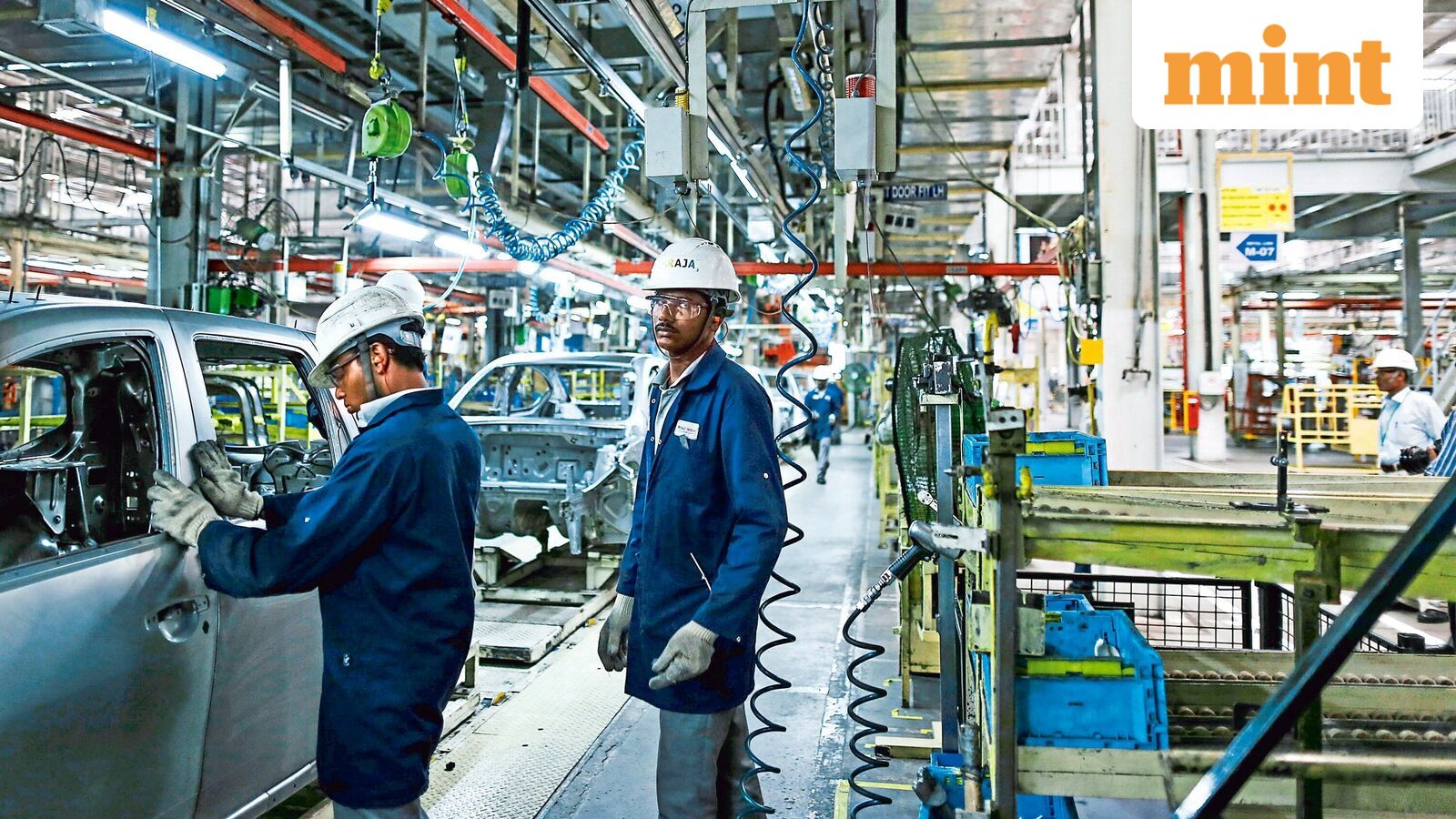
Instead of focusing mainly on subsidies or tariff support, the budget is likely to emphasise simpler rules, faster approvals and a more predictable regulatory environment, aimed at helping manufacturers move up the value chain and sell higher-value products in global markets.
According to the first person cited above, who requested anonymity, the government believes manufacturing must do more of the heavy lifting in India’s long-term growth, as the services sector, while performing well, has limitations in transforming the industrial ecosystem.
“The plan is to help the manufacturing sector move up in the value chain and help improve India’s share in global merchandise trade,” this person said.
Recommendations from two high level committees that examined reform proposals will be part of the budget, said the second person, who also spoke on condition of not being named.
Experts said the shift could see announcements to address the ‘regulatory cholesterol’ flagged in the Survey, and steps to build competitiveness, efficiency and technology as key elements of a new-look industrial policy.
The budget may also have announcements around semiconductors, critical minerals and supply chain resilience, treating trade from both economic and security perspectives, experts said.
Manufacturers currently deal with multiple approvals across central and state agencies for factory expansion, environmental clearances and quality certifications—often stretching project timelines by several months, industry executives said.
Officials, however, indicated that the government is unlikely to roll back existing production-linked incentive (PLI) schemes, but future support will be more tightly linked to productivity and technology upgrades.
The Centre’s refreshed approach builds on the Economic Survey’s call for a reset in industrial policy—by cutting compliance costs, reducing regulatory uncertainty, and replacing excessive oversight with a more trust-based system. The survey argued that a stronger, more innovation-oriented manufacturing sector will attract foreign direct investments (FDI), facilitate technology transfer, and support balance of payment stability.
Expectations have gone up about a reform-focused budget with Prime Minister Narendra Modi saying on Thursday that the Survey’s proposals will guide informed policymaking.
The reset of the industrial policy regime comes at a time when major countries around the world are exploring new trade alliances and decoupling from a US economy that is aggressively enforcing tariffs for its strategic considerations.
India’s export challenge, experts said, is no longer about scale but about building capability.
“Without steady gains in productivity and technology depth, India risks remaining stuck in low and mid-value export segments even as global trade becomes more standards- and knowledge-driven,” said Abhash Kumar, assistant professor of economics at Delhi University.
Kumar added that clear and predictable regulations, along with faster approvals, are as important as incentives in helping firms upgrade products, integrate into global value chains, and compete on quality rather than price.
A third person familiar with the discussions said the budget is expected to make rules easier and more predictable, especially for smaller firms. The focus will be on helping manufacturers operate more smoothly—by simplifying compliance, improving access to factories and infrastructure, and encouraging MSMEs in labour-intensive sectors to formalise without increasing their costs—while supporting the broader push to boost exports.
A sustained improvement in investor sentiment will depend on a clear ease-of-doing-business reset, said Rumki Majumdar, economist at Deloitte India. Simplifying compliance, speeding up approvals and reducing regulatory overlap can lower fixed costs for firms and free up capital and management time for expansion, she said.
According to a June 2025 TeamLease RegTech report, India’s manufacturing MSMEs face a heavy compliance burden, with annual compliance costs of ₹13-17 lakh, and over 1,450 regulatory obligations.
Majumdar also said that continuing the push on infrastructure can widen labour‑market access, create new consumption hubs, and help firms locate production closer to emerging demand and export nodes, which will act as a broader demand base. “Accelerating industrial corridors, logistics parks, and multimodal hubs in these regions would further lower supply‑chain costs and improve delivery reliability,” said Majumdar.
The Economic Survey called for a more balanced use of quality control orders (QCOs) to support domestic manufacturing without disrupting supply chains, and experts said the budget is likely to offer clearer direction on easing these frictions. The recent withdrawal of QCOs on around 50 products is being seen as an early signal of this shift.
“India is in a sweet spot with strong economic growth and widespread recognition of our long-term potential,” said Rajnish Gupta, partner, tax and economic policy group at EY India. “To convert this interest into sustained investment, it must become easier for businesses to enter, operate, and even exit.”
Gupta said the government has already begun easing labour, environmental and sectoral regulations, but added that deeper reforms—especially at the state level, including land and building approvals—will be critical to improving the operating environment.
“Recent events like the export restrictions on rare earth magnets have shown the importance of supply chain resilience. India runs a $280-billion merchandise trade deficit,” Gupta said. “There is a need for focused plans for creating domestic capacity in a variety of products – electronics, electrical equipment and chemicals.”