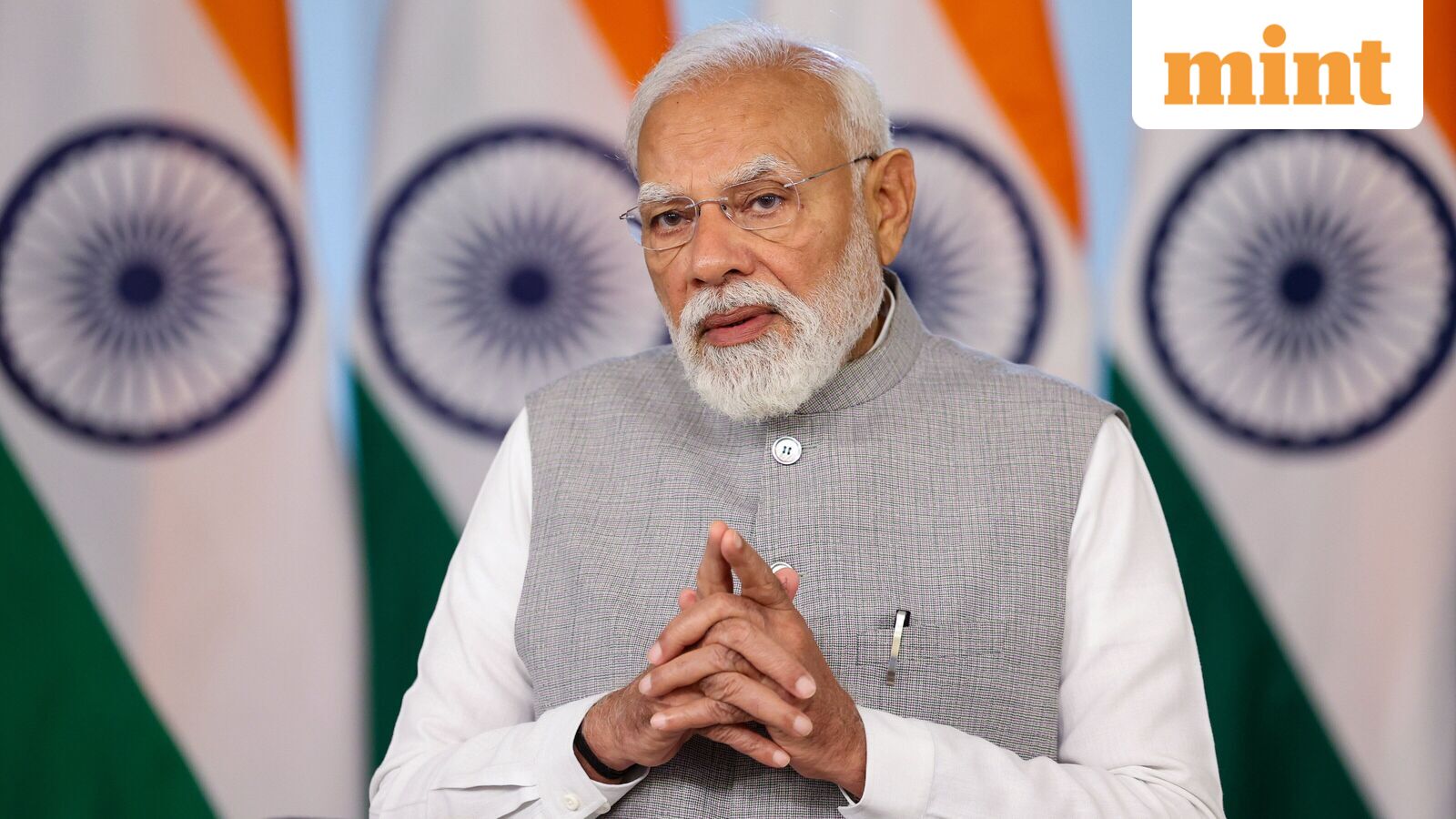
Downplaying the stock market slide on 1 February after the FY27 budget presentation, Prime Minister Narendra Modi on Friday said that the Union budget is a policy roadmap, not a short-term trading document.
Speaking at a post-budget webinar, Modi said budget reforms and allocations must be seen as a part of a long journey.
“Often, the budget is evaluated on various parameters: sometimes the stock market’s movements, sometimes the discussion centres on income tax proposals. The truth is that the national budget is not a short-term trading document; it is a policy roadmap,” he said.
Indian stocks tumbled as much as 3% in intraday trading on 1 February after Union finance minister Nirmala Sitharaman announced a hike in the securities transaction tax (STT) on futures to 0.05% from 0.02%, and on options to 0.15% from 0.01% in her budget speech, before recovering some losses and closing 2% lower.
“Budget decisions related to these factors provide lasting strength to the economy and, most importantly, no budget should be viewed in isolation,” said Modi.
He also called for the industry to come forward with fresh investments and innovation.
“Anyone can create a policy framework, but its success depends on all of you. Industry must come forward with fresh investment and innovation. Financial institutions and analysts must help develop practical solutions and strengthen market confidence,” he said.
He also said the government, industry, and academia should come together to turn reforms into results.
“I suggest that we develop a clear Reform Partnership Charter. This should be a shared resolution of the government, industry, financial institutions, and academia. This charter will become a very important document in the journey towards a developed India,” he said.
“Reforms should be evaluated not by mere announcements, but by their impact on the ground. We must increase transparency, speed and accountability through extensive use of AI, Blockchain and data analytics, as well as continuous monitoring of the impact from grievance redressal systems,” he said.
Modi said the government is working on simplifying the foreign investment framework, to make the system more predictable and investor-friendly.
“We are also taking steps to improve long-term finance and make bond markets more active. The process of buying and selling bonds is being simplified,” he said, adding that we must view bond market reforms as enablers of long-term growth.
“We must ensure predictability, deepen liquidity, introduce new instruments, and effectively manage risks. Only then will we be able to attract sustainable foreign capital,” he said.
Modi’s remarks follow the FY27 budget announced by Sitharaman, which called for a capex of ₹12.2 trillion, along with developments in sectors such as MSMEs, biopharma, semiconductors, and critical minerals.
The government’s budgetary reforms come amid global economic uncertainty, largely due to steep US tariffs imposed on multiple trade partners.
Earlier in February, the US Supreme Court deemed these tariffs illegal, with president Donald Trump then putting a 10% tariff across the board for all nations.