Most respondents to the poll are still seeking a populist approach in the Budget, and are hoping for further tax relief and some exemptions under the new tax regime.
Mint conducted a poll of its digital and print readers between 4 December 2025 and 26 January 2026 to capture public views on the upcoming Budget and to gauge what they want the government to prioritize this time. A total of 1,674 readers answered the poll. The sample is not representative of the population.
Finance minister Nirmala Sitharaman is set to table the Union Budget for 2026-27 on Sunday, 1 February.
The poll captured views on last year’s tax slab changes and their impact, expectations from the Budget, whether further populist measures are warranted, the need for targeted schemes for women, farmers and entrepreneurs, and the timeframe the government should think of in its policymaking in pursuit of the goal to make India a developed economy by 2047.
Priorities for Budget 2026
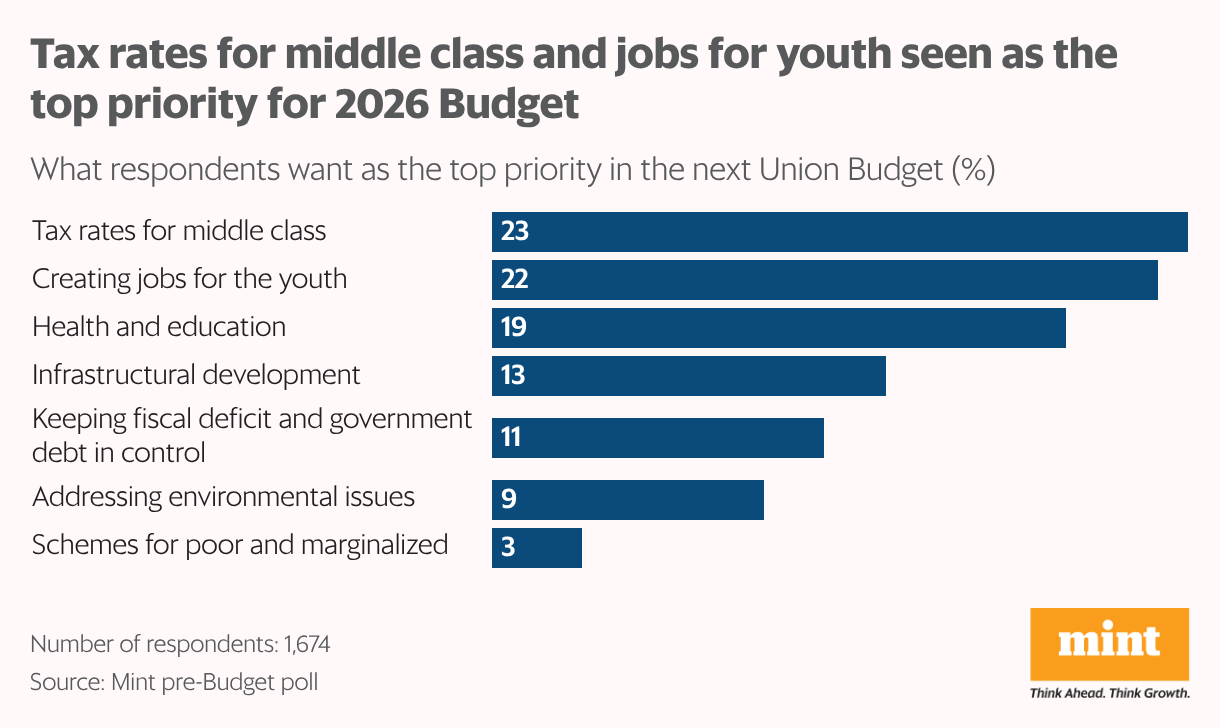
When asked about their preferred top priorities for the Budget, the option “tax rates for the middle class” turned out to be the most popular, with 23% of votes, even though the past year saw income tax slab relaxations and cuts in goods and services tax (GST) slabs.
About 22% of respondents want job creation for the youth prioritized in Budget 2026, signalling that employment remains an immediate concern for households.
Participants of the poll could only pick one out of the seven options provided.
Health and education (19%), infrastructure development (13%), and controlling the fiscal deficit (11%) seemed to be the top priority for fewer respondents.
Tax cuts find favour
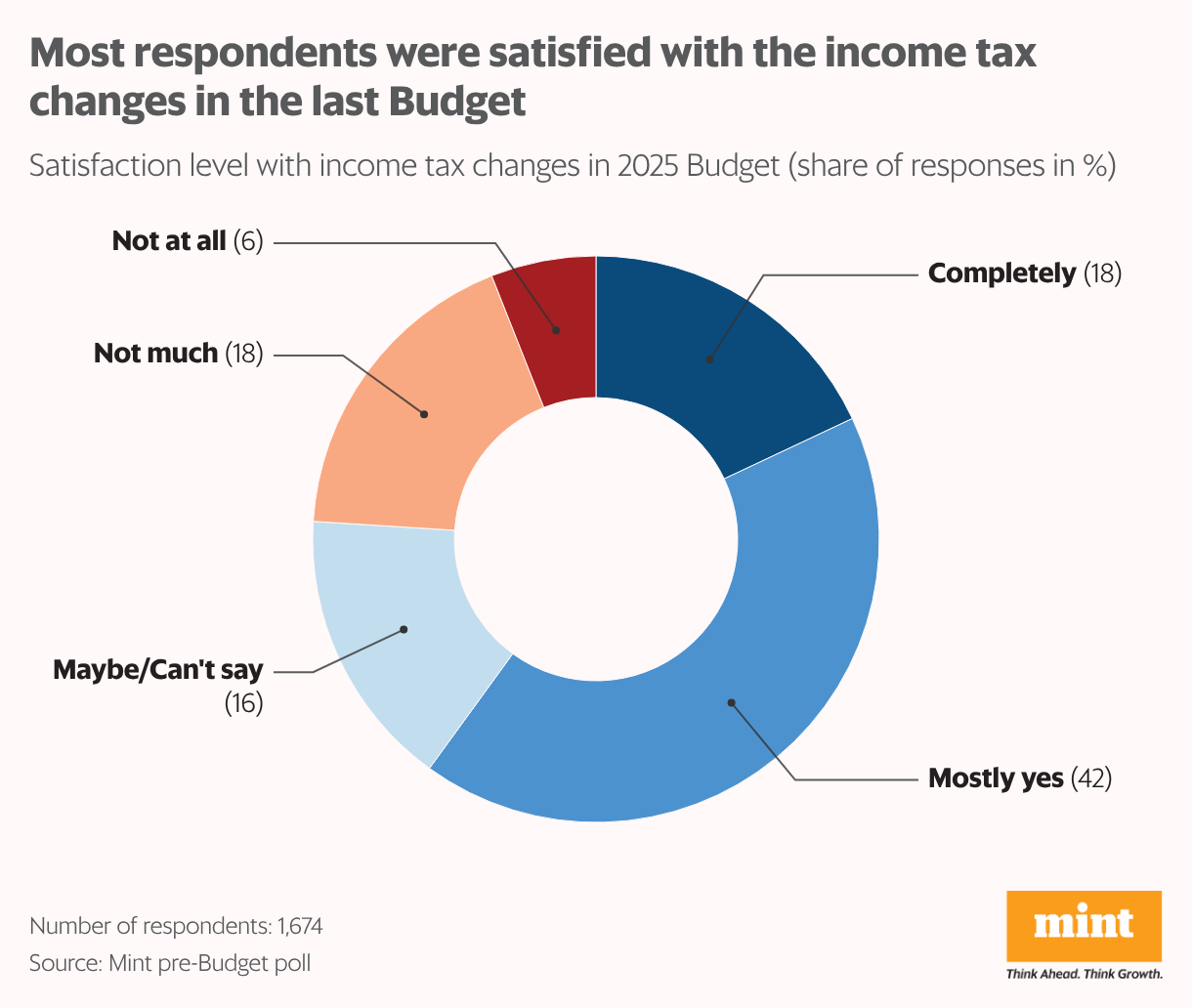
In the previous Union Budget, the government announced significant personal income tax relief under the new tax regime. The tax-free income threshold was effectively raised to ₹12 lakh through a higher rebate under Section 87A, and to ₹12.75 lakh for salaried taxpayers after the standard deduction.
Fast forward 11 months, and nearly 60% of respondents said they were satisfied with these changes—18% were completely satisfied, and 42% largely so. Furthermore, 57% of the respondents said the tax cuts had a material impact on their daily lives.
However, as mentioned earlier, the poll suggests the middle class wants to be merrier still, with tax rates ranking as top priority for respondents ahead of the Budget.
Demand for populism remains
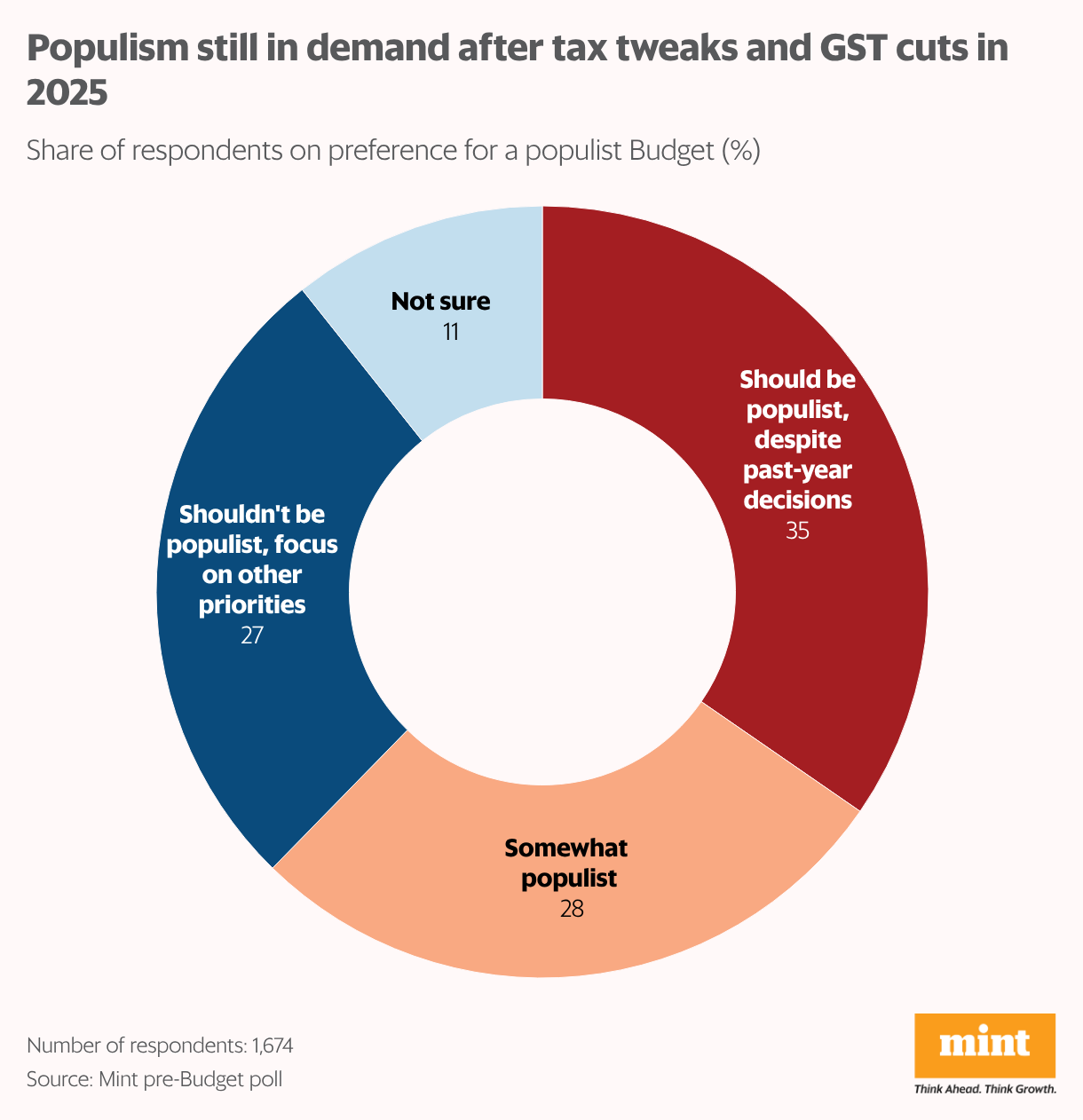
Despite people-centric changes in the previous Budget, the poll reflects continued demand for a populist approach in the 2026 edition. As many as 35% of respondents favoured a populist Budget despite last year’s measures, while another 28% preferred a somewhat populist approach.
Put together, the responses indicate that while last year’s Budget offered some relief, many people still feel the need for more direct support.
Favoured groups
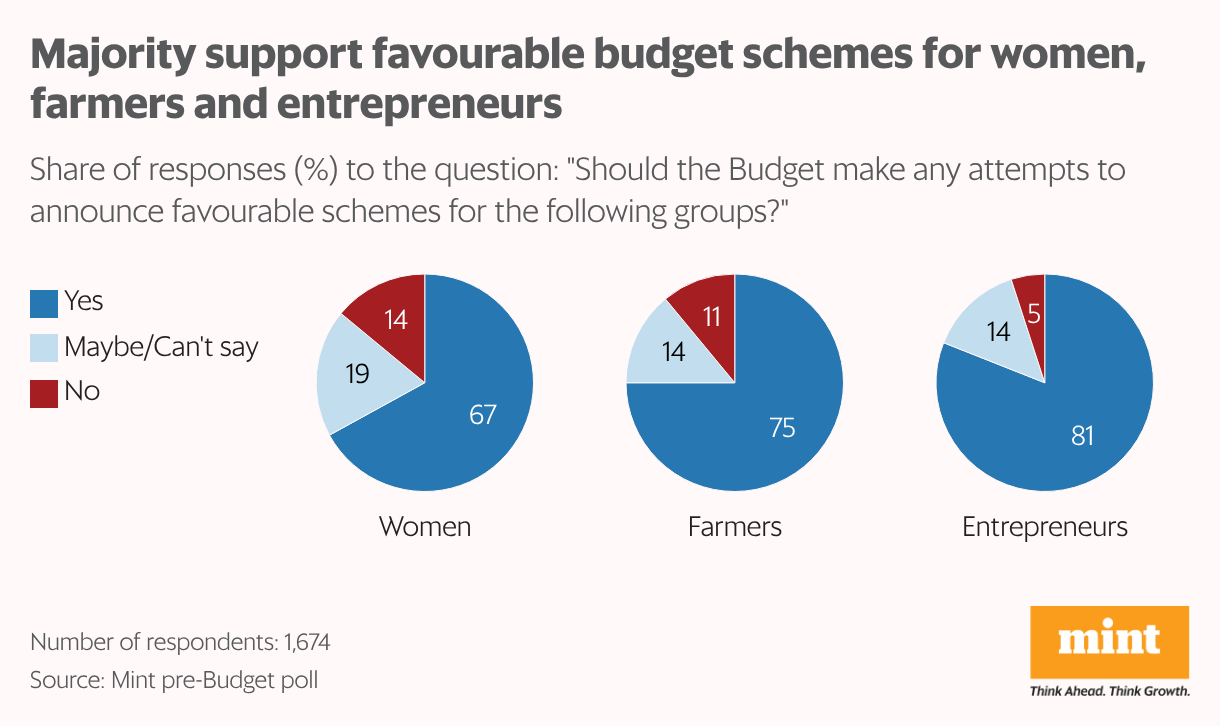
A large share of respondents want schemes and policy steps to uplift women, farmers, and entrepreneurs. About 67% of respondents favoured targeted schemes for women, with this share rising to over 75% for farmers and more than 80% for entrepreneurs and startups. This demand persists despite the presence of several ongoing support programmes, suggesting that respondents are seeking either wider coverage or higher budgetary allocations.
Preference for shorter horizons
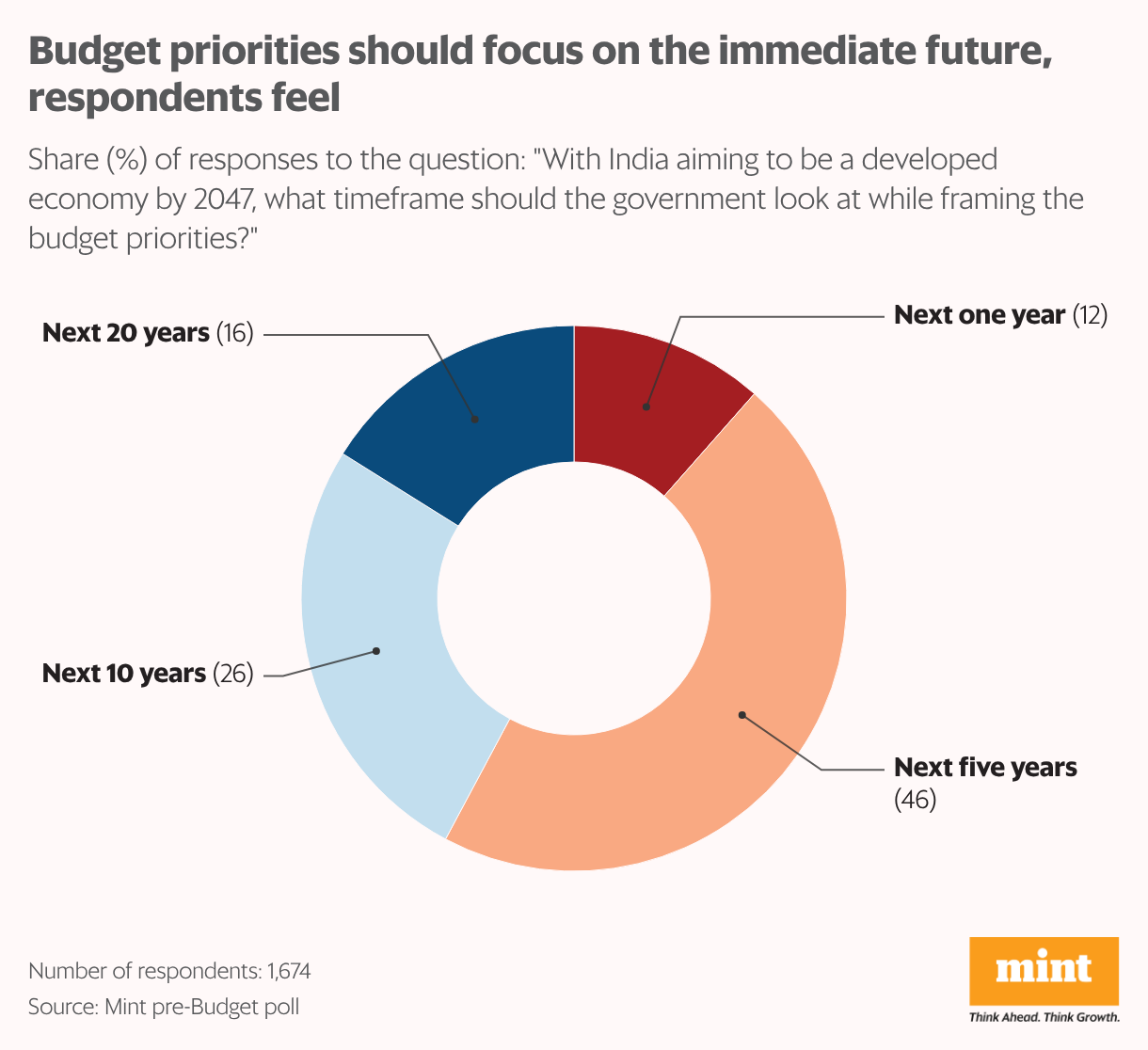
India’s long-term development ambition is encapsulated in the current government’s “Viksit Bharat 2047″ vision, which aims to transform the country into a fully developed nation by the time India completes 100 years of independence. However, the poll suggests that respondents are more inclined towards shorter-term planning during the Budget exercise.
When asked about the timeframe the government should think of while framing Budget policies, 58% didn’t think of longer than a five-year window, while 26% pointed to a 10-year horizon. Only 16% said the government should look as far ahead as the next 20 years.
Budget matters
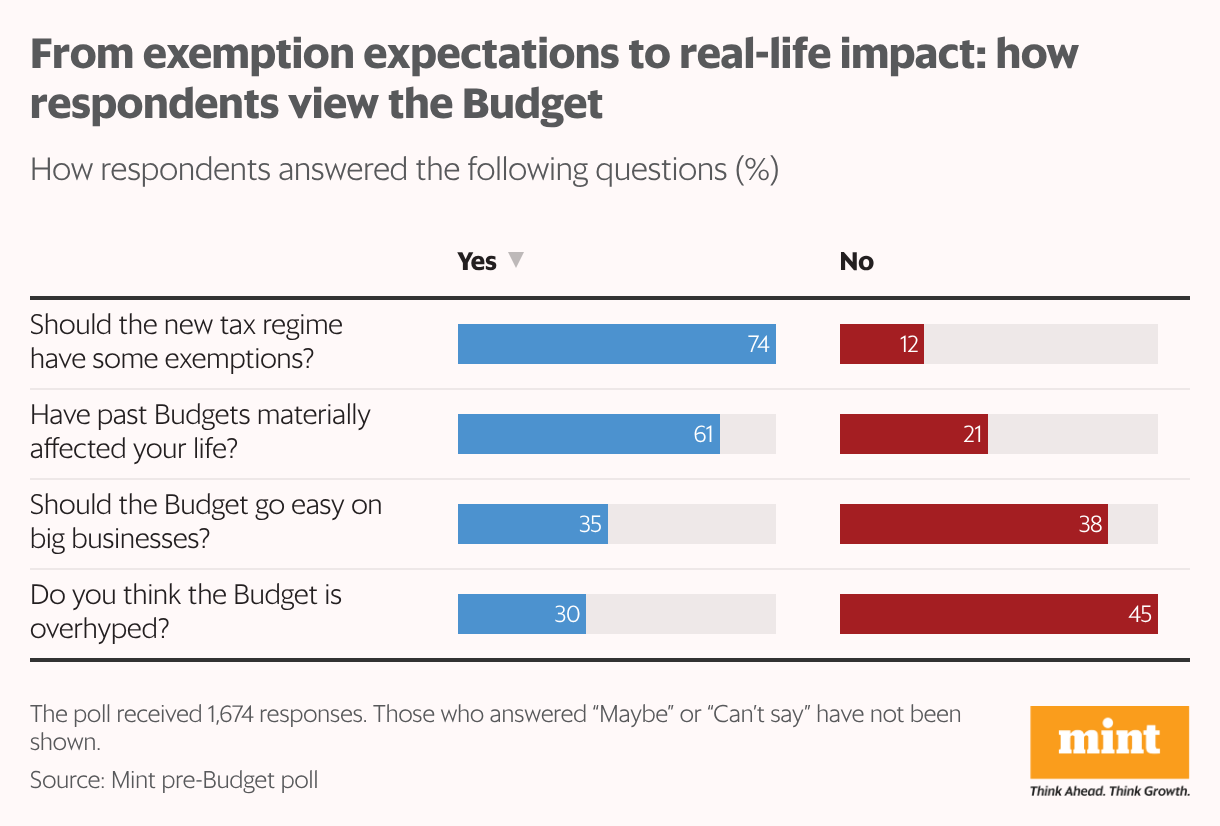
Responses to a few other questions highlight the central role the Budget plays in people’s lives and how closely it is tracked. Six in 10 respondents said past Budgets have had a material impact on their lives. When asked whether the Budget is overhyped, 45% of respondents said it is not, far more than 30% who said it is (the rest were not sure).
While there is strong demand for a populist Budget that favours entrepreneurship, farmers, and women, many respondents were less inclined towards the idea of the Budget going easy on big businesses to keep them satisfied.
Around 74% of the respondents want some exemptions in the new tax regime. At the same time, nearly 70% of respondents called for an increase in the exemption limit of ₹1.5 lakh under Section 80C of the Income Tax Act under the old tax regime. This limit was last raised from ₹1 lakh in FY15 and has remained unchanged since.
Taken together, the responses suggest that while people value fiscal relief and targeted support, they want the Budget to continue its focus on the salaried middle class.