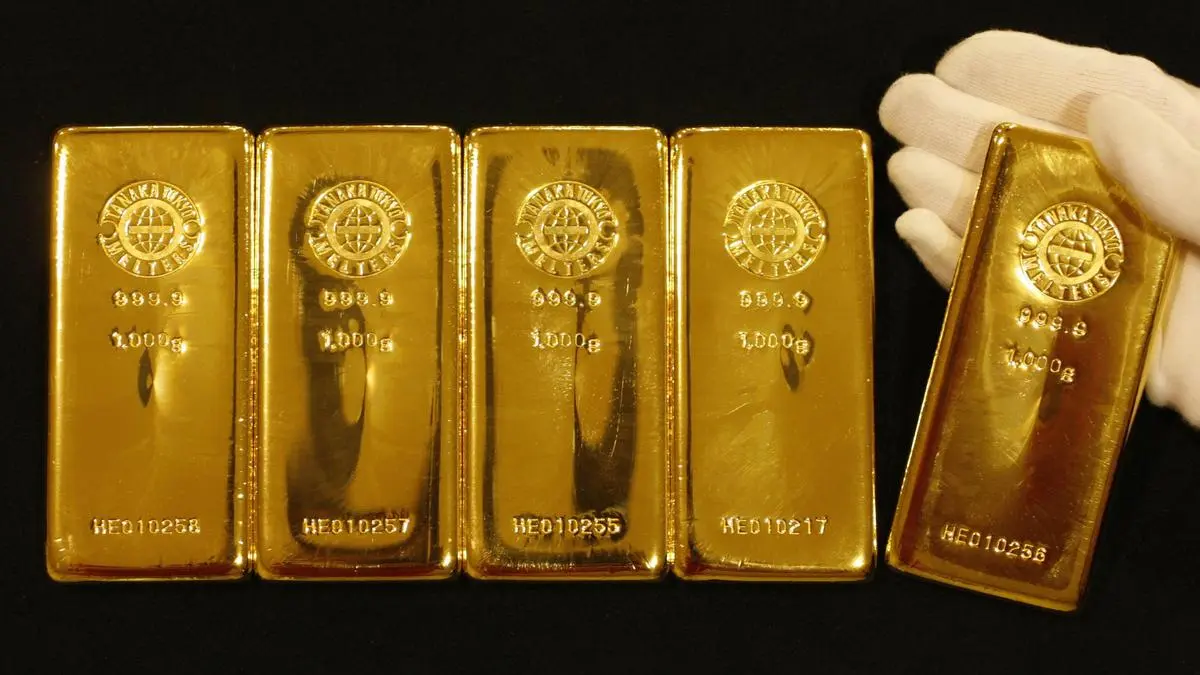

On Monday, the yellow metal was quoted at $4,007.3 at 1815 hours IST.
| Photo Credit:
MicroStockHub
Every dollar inflow into physically backed gold exchange-traded funds (ETFs) was matched by a similar outflow last week, with the US and Japan leading investors’ exits, data from the World Gold Council (WGC) showed.
While inflows into the ETFs were $1.668 billion, outflows were $1.67 with the 16 tonnes demand for gold matched by unwinding of 16.2 tonnes of the precious metal.
Investments and exits were equally matched as gold was range-bound near $4,000 an ounce last week. On Monday, the yellow metal was quoted at $4,007.3 at 1815 hours IST.
‘Unusual trend’
“Gold fell sharply last week as an unusual trend emerged: War in West Asia pushed prices down instead of up. Oil surged nearly 13 per cent on US-Iran clashes and Hormuz threats, reviving inflation fears and raising expectations of a September Fed hike,” said Prithviraj Kothari, Managing Director at RiddiSiddhi Bullions Ltd and President of India Bullion and Jewellers Association Ltd.
Central banks, led by China, kept buying, while Western ETF holdings and Indian retail demand stayed weak. Sentiment remains cautious-to-bearish, with fair value near $4,100 for gold, he said.
Gold futures slipped a little over 2 per cent last week, said Renisha Chainani, head of research at Augmont.
Hawkish Fed chief
“US Fed Chair Kevin Warsh sounded hawkish in his Congressional testimony, Dallas Fed President Lorie Logan openly pushed for another rate hike, and Vice Chair Philip Jefferson said he’d support tighter policy if inflation doesn’t improve soon. Markets now see roughly a 50 per cent chance of a September hike — a major shift that weighed heavily on metals all week,” she said.
Last week, exits in North America were $365 million, followed by Asia at $173 million. Europeans invested $530 million. Country-wise, US exits were $507 million, and in Japan, they were $261 million.
On the positive side, UK investors invested $370 million in gold ETFs, followed by Canadians, who chipped in with $141 million. Inflows in China were positive at $88 million.
China, India top infows
Year-to-date, inflows into gold ETFs as of July 20 were $83.95 billion, while outflows were $76.33 billion. Net inflows were negative only in the US, to the tune of $8.72 billion. Asia continued to top investments at $11.94 billion, with Europe witnessing positive inflows at $4.18 billion.
Country-wise, as of July 17, the highest exits have been witnessed in the US ($9.07 billion), followed by France at $333.5 million and Italy at $210 million.
China leads in net positive inflows at $5.39 billion, with India being next at $3.87 billion. Other countries where net investments are positive are: the UK ($2.49 billion), Switzerland ($2.06 billion) and the Hong Kong Special Administrative Region ($944.7 million).
Cautions-to-bearish sentiment
Chainani said the sentiment was “cautious-to-bearish” for now, with the market pulled between geopolitical risk on one side and hawkish rate expectations on the other.
Gold, which soared to $5,608 an ounce on January 29, has shed over 27.5 per cent since then. Iran has been the primary reason for the fall, as investors expected a hike in US Fed interest rates, feared inflation, switched to crude oil futures and found bond yields attractive.
Since 2024, the precious metal has witnessed a stupendous rally on hopes of a US Fed rate cut, geopolitical crisis and the trade war between the US and other countries, particularly China.
Published on July 20, 2026