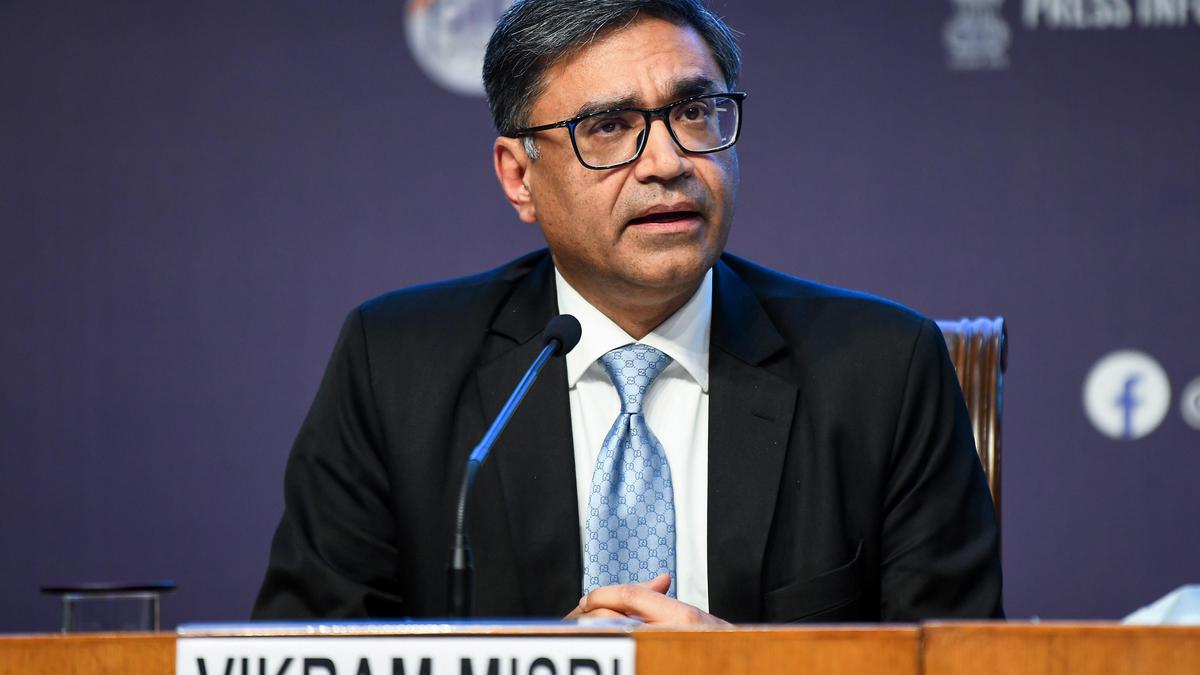
India’s oil imports will be guided by “national interests”, said Foreign Secretary Vikram Misri on Monday (February 9, 2026), but did not refute U.S. President Donald Trump’s claim that India has committed to stop buying Russian oil. Mr. Misri’s statement came even as the government prepared to brief parliamentarians about the trade deals finalised with the European Union and the U.S., as well as on trade ties with Bangladesh.
A notice sent out on Monday (February 9, 2026) said that the External Affairs Ministry will brief the Parliamentary Standing Committee on External Affairs, chaired by senior Congress leader Shashi Tharoor, on Tuesday (February 10, 2026). Meanwhile, the Opposition stepped up its attack over issues surrounding the trade deals, including the impact on farmers, and the government’s refusal to confirm or deny Mr. Trump’s assertions.
“What I can firmly and confidently say is that whether it is the government or indeed our business [sector], at the end of the day, national interests will be the guiding factor for us in our choices,” Mr. Misri told journalists at a briefing meant to discuss the visit of Seychelles President Patrick Herminie in India. Mr. Misri said that the key drivers of India’s energy policy are “adequate availability, fair pricing, and reliability of supply” calling it a “rather complex matrix of issues”.
However, he did not respond or comment directly on the U.S. President’s Executive Order issued on Friday (February 6, 2026) that, while cancelling punitive 25% tariffs on India, said that India had already begun to stop buying Russian oil, and threatened to resume the tariffs if India buys more.
“Our approach is to maintain multiple sources of supply and diversify them as appropriate to ensure stability. Therefore, I would say that the more diversified we are in this area, the more secure we are,” Mr. Misri added.
Falling imports
While nearly 25% of India’s oil imports are still being sourced from Russia, India is expected to raise its imports from other countries including the U.S. and Venezuela. As The Hindu reported last week, India’s purchases of Russian oil were down to a 38-month low in December 2025, and a number of news agencies confirmed on Monday that India’s major refiners Indian Oil, Bharat Petroleum, and Reliance Industries have so far avoided advance orders for the month of April entirely.
Thus far, however, the government has neither confirmed nor denied the U.S.’s contention that it has agreed to ending its Russian oil imports. When asked last week about the deal, External Affairs Minister S. Jaishankar fielded questions to Commerce Minister Piyush Goyal, while Mr. Goyal said that questions on Russian oil would be answered by the External Affairs Ministry.
“On the Russian oil issue and the India-U.S. trade deal – the Commerce Minister says, ask the External Affairs Minister, the External Affairs Minister says ask the Commerce Minister, and the Petroleum Minister is preoccupied with other issues,” Congress general secretary Jairam Ramesh said in a post, adding that this contrasted with Prime Minister Narendra Modi’s policy of a “whole of government” approach.
Also Read | Ensuring energy security of Indians is top priority, says MEA after U.S. claim on Russian oil purchase
In addition, the Ministry is expected to field questions from the members of the parliamentary committee on the impact of the FTA with the EU and the joint statement with the U.S.
In a pre‑briefing note to the panel, the Ministry shared details of the EU agreement, as well of trade figures with Bangladesh. Underscoring the significance of the deal, the government said the EU is well‑positioned to shape “international standards and narratives”. India and the EU, it added, are now “natural and preferred partners”.
The Ministry highlighted that over the past two years, there have been more than 30 visits at the head‑of‑state or government-level between India and Europe, along with more than 150 ministerial‑level engagements. Under the FTA with the EU, India has secured preferential access to European markets across 97% of tariff lines, covering 99.5% of trade value, it said.
The Ministry note on U.S. trade outlined the benefits of the trade deal being negotiated. While it mentioned Mr. Trump’s executive order, it omitted mentions of the contentious portions, including the Indian “commitment” on ending oil imports from Russia.
On Bangladesh, the Ministry is expected to explain the downturn in trading ties and connectivity due to tensions in bilateral relations with the Yunus administration in Dhaka, with hopes of a reset once an elected government is in place after elections on February 12. According to the figures, India’s exports to Bangladesh came down from $11 bn in 2024-25 to $8bn in the year 2025-26 till date.
Published – February 09, 2026 10:19 pm IST