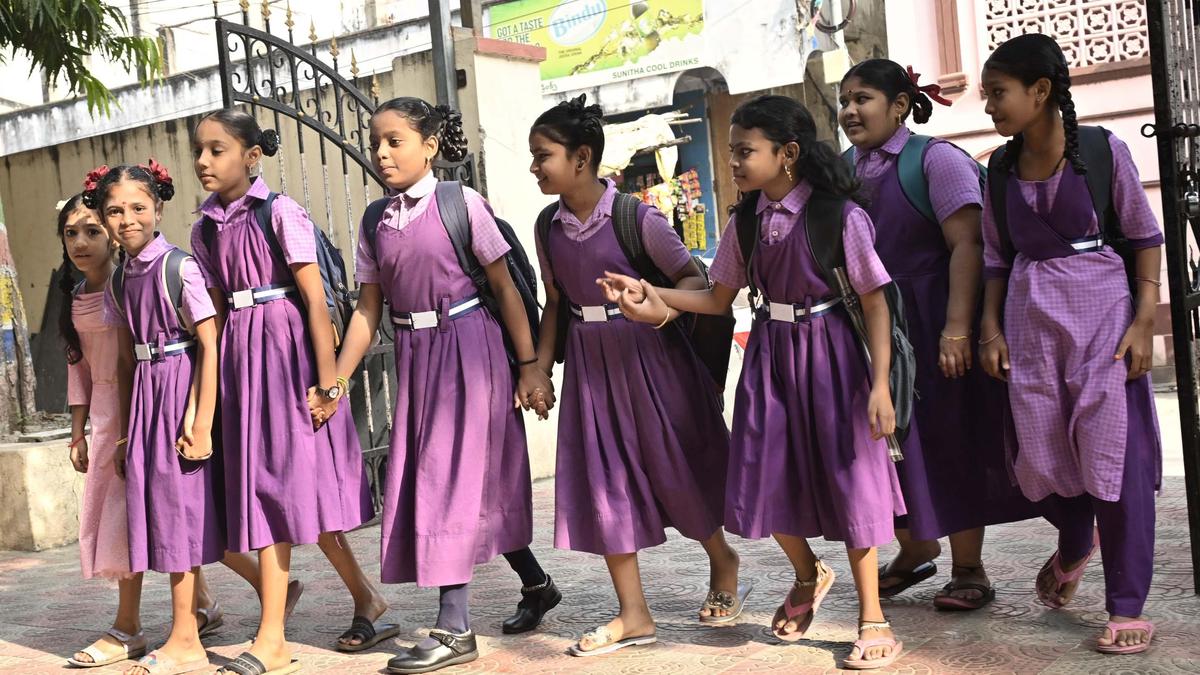
A key issue in achieving the target set by the National Education Policy (NEP) 2020 to increase expected years of schooling in India to 15 years (it is currently 13 years) was the “uneven distribution of schools”, the Union government said on Thursday (January 29, 2026) in its report on the Economic Survey of India 2025-26, released ahead of the Budget. Only about 17% schools provide secondary education in rural areas, it showed, and about 38% schools provide secondary education for urban areas.
The report on the Economic Survey of India showed that this corresponded with other sources of data that said the largest number of out-of-school children were of secondary school age (between 14 and 18 years), adding that the need to supplement household income, and domestic and care responsibilities continued to be the leading reasons for school dropouts.
Read: Economic Survey 2025-26 LIVE
“Building state capacity in higher education, fostering academia-industry collaboration, and expanding global engagement can further enhance the education system’s responsiveness to the changing needs of the economy,” the report said in its chapter discussing education. The report also touched upon the newly introduced Viksit Bharat Shiksha Adhishthan Bill, 2025 intended to “replace fragmented, overlapping regulations”, and focused on policy interventions needed for the “internationalisation” of higher education.
“Notable gains in school enrolments and higher education sector, and improvement in innovation index also reflect how PM Modi’s ‘reform express’ is fulfilling aspirations, driving transformations and ensuring inclusive growth,” Union Education Minister Dharmendra Pradhan said on Thursday (January 29, 2026), commenting on the outlook on education in the Economic Survey.

Mr. Pradhan also shared a snapshot of the report’s section on education, which highlights that India now has 23 Indian Institutes of Technology (IITs), 21 Indian Institutes of Management, and 20 All India Institutes of Medical Sciences, along with establishing two international IIT campuses (in Zanzibar and Abu Dhabi). The snapshot also highlighted the Gross Enrolment Ratio at the primary (90.9%), upper primary (90.3%), secondary (78.7%), higher secondary (58.4%), and higher education (29.5%) levels.
School education
While India had improved enrolment at early levels of school education, the “secondary age-specific net enrolment (NER) remains low at 52.2%, highlighting the need to retain students beyond Grade VIII,” the Economic Survey report said. “To fully convert its vast human resource base into high quality human capital, India needs to raise its EYS (Expected Years of Schooling) to 15 years set by NEP’s 5+3+3+4 schooling structure for ages 3-18.2,” the report added.
Citing data from the Periodic Labour Force Survey of 2023-24, the report notes that nearly two crore adolescents aged between 14 and 18 years were out of school. “The single largest reason for adolescent dropout is the need to supplement household income, accounting for 44% of dropouts,” it added. While over 67% boys cite the need to supplement household income as a reason for dropping out of school, 55% girls reported domestic and care responsibilities as the “major constraint”, the report said.

“High dropout rates, driven by economic pressures, make integrating school-based vocational and skills education an urgent priority,” the report noted, adding that current data from the Periodic Labour Force Survey 2023-24 showed that only 0.97% of adolescents aged between 14 and 18 years had received institutional skilling, with 91.94% having received none.
Further, it noted that among those trained formally, over 52.9% are concentrated in the sector of Information Technology and IT-enabled services, which the Economic Survey 2025-26 said points to a “strong demand for digital skills but also signalling limited access to formal training in other high-potential sectors”.
On learning outcomes, the report cited the PARAKH 2024 findings of Grade III assessment to say that this “showed promising recovery post-COVID”, however adding that these findings had also revealed that “only 35% of schools accommodate children with special needs, and just 38% have trained teachers”. “Emotional well-being indicators are similarly concerning”, it added, citing data that only 55% of students felt motivated to attend school, and “less than half” felt “emotionally safe”.
Higher education
A major thrust of the Economic Survey of India 2025-26 report’s section on higher education is on the need to “internationalise” the sector, along with developing State capacities for higher education, considering that over 81% of higher education enrolments were in State institutions. It also states the importance of following through on the NEP 2020’s vision for a ‘light but tight’ regulatory framework through the introduction of legislation, including the Viksit Bharat Shiksha Adhishthan Bill, 2025, meant to subsume the functions of the University Grants Commission, the All India Council for Technical Education, and the National Council for Teacher Education into a single overarching regulatory Commission.

Data in the Economic Survey showed that the number of universities, colleges, higher educational institutions, and medical colleges had all risen significantly since 2014-15, with the highest rise reported in the number of medical colleges from 387 to 819. The number of universities saw a rise of about 76% in this time, with the number of higher educational institutions and colleges reporting a rise of about 35% each.
In the section on “internationalising” higher education, the Economic Survey report cited heavily from a NITI Aayog report on the subject released in December 2025. “To position India as an education hub, broader strategies need to be deployed,” it said.
The report went on to suggest measures for programme diversification beyond full degrees, including summer schools, semester-abroad modules; “promoting reciprocal student mobility” through bilateral agreements; enhancing aspects of campus experience with housing, health, counselling, insurance, and visa services, etc.; simplifying regulations through faster visas, post-study internships, and others.

On the Viksit Bharat Shiksha Adhishthan Bill, 2025, the Economic Survey said this Bill “aims to facilitate the establishment of globally benchmarked institutions within the country, thereby retaining domestic talent and attracting international students and faculty”.
“It will strengthen institutional autonomy, especially for Institutions of National Importance, and enable more uniform standard-setting and coordinated growth of the higher education ecosystem,” it added.
Published – January 29, 2026 04:16 pm IST