The 1 February announcements by finance minister Nirmala Sitharaman will focus on schemes enabling export diversification, market access and improving the quality of goods manufactured in India, said one of two people quoted above–both spoke on the condition of anonymity.
The government is also finalizing policies to further integrate the Indian manufacturing sector with global supply chains, while reducing import dependence on commodities, select products and capital goods, said both people. Reforms and measures to improve the ease of doing business and bolster the industry’s competitiveness will be another highlight, they said.
One of the key themes of India’s upcoming Union budget, the first after US tariffs rocked global trade last year, will be to de-risk the economy from prolonged headwinds by announcing reforms and incentives for manufacturers, small businesses and exporters, according to two persons familiar with discussions.
The 1 February announcements by finance minister Nirmala Sitharaman will focus on schemes enabling export diversification, market access and improving the quality of goods manufactured in India, said one of two people quoted above–both spoke on the condition of anonymity.
The government is also finalizing policies to further integrate the Indian manufacturing sector with global supply chains, while reducing import dependence on commodities, select products and capital goods, said both people. Reforms and measures to improve the ease of doing business and bolster the industry’s competitiveness will be another highlight, they said.
“The idea is to address the risks to the economy from overall global uncertainty, not from any specific market,” said the first person, citing that improved quality of manufacturing will help Indian products to excel in multiple markets.
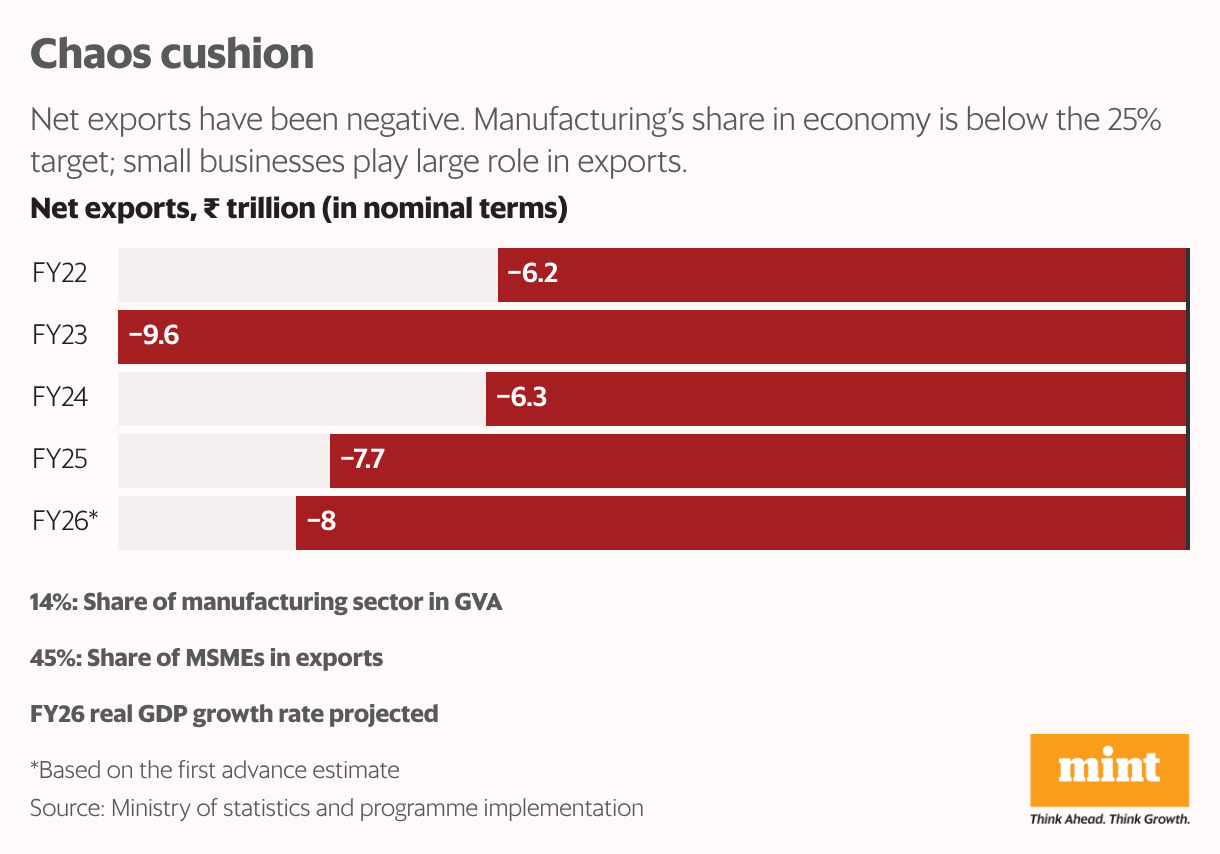
India has stayed resilient even as global trade shifts from an era of hyper-globalization to a more protectionist landscape after US President Donald Trump imposed tariffs on trading partners in August last year. India’s total merchandise exports during April-December rose to $330.29 billion from $322.41 billion a year earlier, while imports increased to $578.61 billion, resulting in a trade deficit of $248.3 billion. Exports rose despite 50% tariffs imposed by the US, the country’s largest trading partner.
Queries emailed to the finance and commerce ministries on Friday remained unanswered.
The government has been trying to cushion the domestic economy with measures, including reductions in direct and indirect tax rates, a sustained focus on infrastructure, and faster negotiation of free-trade agreements with other nations.
Lifting manufacturing standards
“The next phase of strategy must therefore shift from stimulus to competitiveness. Policy focus should be on lowering the effective cost of doing business through regulatory simplification, logistics efficiency and predictable compliance, while sustaining investment in core infrastructure and priority industrial sectors that anchor long-term growth,” said Rishi Shah, partner and economics advisory lead at Grant Thornton Bharat LLP.
Equally critical is a stronger push on innovation with incentives for genuine intellectual property creation rather than scale alone, said Shah. A focused programme to upgrade quality standards across micro, small and medium enterprises (MSMEs) would strengthen India’s integration into global value chains, added Shah.
“Ultimately, resilience will come from clarity on what India can competitively offer the world and a sustained commitment to economic transformation over the next two decades,” said Shah.
According to the people quoted earlier, the budget may propose deeper alignment of Indian manufacturing standards with international norms, coupled with financial support for testing, certification and compliance, especially for MSMEs, to improve the quality of manufactured products to make Indian goods globally competitive.
The focus would be on expanding domestic testing infrastructure, faster accreditation of laboratories and incentives for firms adopting global quality benchmarks in sectors such as engineering goods, electronics, textiles, toys and consumer products, where quality perception plays a decisive role in export success, they said.
The recent announcements of close to 100 new voluntary quality control standards is one such step taken prior to the budget.
Targeted subsidies
For India, a major concern is China’s threat to disrupt the supply of structurally and strategically important rare-earth metals. The government may use the budget to create a narrow list of critical goods where domestic capacity remains weak but is strategically important.
These could include electronic components, semiconductors and display panels; capital goods such as precision machinery and industrial robots; clean energy inputs such as solar wafers, cells and battery storage systems; pharmaceutical bulk drugs and key chemical intermediates; and select defence and aerospace components.
Budget may announce measures to focus on targeted capital subsidies, lower import duties on raw materials and long-term procurement commitments to encourage domestic manufacturing, while ensuring costs do not rise for downstream industries.
Making exports competitive
Scale, cost competitiveness and branding are factors that could make Indian goods winners in global markets. Accordingly, the budget may announce export-linked incentives for companies that achieve scale thresholds, support cluster-based manufacturing to lower logistics and input costs. The finance minister may also offer funding for design, branding and marketing of Indian products overseas, particularly in labour-intensive sectors such as textiles, footwear, furniture and food processing.
The announcements could also focus on strengthening trade finance, expanding export credit insurance and increasing funding for market access initiatives, a move aimed at helping exporters to reach more markets amid trade disruptions, the people quoted earlier said.
“The government should continue to implement ease of doing business reforms such as reducing tax litigation, alternative dispute mechanisms, safe harbour and presumptive tax regimes, streamlining construction permits and accelerating environmental approvals. Leveraging the recent reforms on labour, reforms in other factor markets such as land and electricity need to be carried out,” said Sameer Gupta, National Tax Leader, EY India.
One expectation from the Budget for 2026-27 (FY27) is the rationalization of customs duties so that the levies on raw materials, intermediate goods, and final goods drive domestic manufacturing and value addition.
Budget is also likely to incentivize multinational firms to source a higher share of inputs from India, easing customs procedures for intermediate goods, and creating plug-and-play manufacturing zones linked to ports and logistics hubs.
The government is also likely to focus on encouraging joint ventures, technology partnerships and supplier development programmes that allow Indian firms, particularly MSMEs, to become reliable vendors to global manufacturers, which could anchor India more firmly into international production networks, said the second person quoted above.